Showing posts with label #poetrymonday. Show all posts

Tuesday, October 10, 2017

The single space of the present moment (Nantucket is for lovers)

Here’s another essay from ModPo, this time on William Carlos Williams’ “Nantucket” - because I don’t post poetry essays here nearly enough.

The poem can be read in its entirety here: https://www.poemhunter.com/poem/nantucket/

The most striking aspect of William Carlos Williams’ poem “Nantucket” is the lack of a poetic speaker. The poem is written entirely in present tense and moves like a camera across a fixed, silent tableau. We have a lyrical description of a room: flowers against the curtains, with sun shining in. There is no sign of human habitation but we know, by the readiness, the pitcher and tumbler, and the tidy presentation, that the room has been set up. We know it is late afternoon, and that the room is unoccupied (“immaculate”), private (the phallic, prone “key”) and that occupation is imminent. The images are crisp, richly coloured, concrete and very visual, with a strong sensuality conveyed by scent (“Smell of cleanliness”), sight (lavender, yellow, white), and feel (sunshine). This is a poem that presents a classic example of Imagism. There is no sentiment expressed. Williams’ language is economic and clear, focusing only on this single space of the present moment: a self-contained room. Most of the scene is set using nouns: flowers, curtains, sunshine, a glass of water, a key, a bed.
In spite of the pristine nature of the poem’s imagery and the lack of a narrative, there is a dynamic quality to the work. A judicious use of transitive verbs: “changed”, “turned down”, “lying”, charge the nouns with a strong sensual quality, as if these items were readying themselves for something to follow, and contained by the clear space of the room with its obvious borders. There is a strong sense of distinction between the self-contained world inside the room (white on white), and outside of the room (colour on colour). Additional motion is conveyed by the use prepositional phrases like “through the”, “changed by”, “on the”, “by which” and “is lying” which give the nouns a sense of agency and connection, so that each one’s placement is part of the meaning of the other and exists only in conjunction with its precedent.
The poem has a very consistent structure and rhythm, which also provides a motion that contrasts strongly with the static nature of the imagery. The five two line stanzas don’t rhyme but have a very regular syllabic pattern of 6/6, 6/5, 7/4, 7/4, 7/6, heighted by the way the syllables are accented, swapping between iambic and trochaic rhythm which also creates a kind of motion - like a dance between alternating stresses. You don’t need to read these stresses with overt iambic and trochaic patters, but the ghost of that rhythm keeps the work light and bouncy. Enjambment, particularly in the second half of the poem, and dashes are both used to introduce a sense of emotive progression as the reader’s eye moves down the page from the window to the bed, preceded by the dash and capitalised preposition “And the”, as if the bed were our destination, and the slow progression from window to bed was one of desire and consummation.

Tuesday, September 26, 2017

Emily again: Love reckons by itself — alone

If you’ve been following this blog, you’ll know about my annual affair with UPenn’s Modern and Contemporary American Poetry course (“ModPo”) taught by the great Al Filreis. I’m on my sixth year.  This is no impersonal MOOC, though I share the course with some 30,000+ students, most of whom will return every year to re-engage with old and new poems, as the course is constantly changing, growing, and offering new ways to interact with both classic and very recent poetry and poets. The course runs for 10 weeks but remains open throughout the year with discussion groups, ongoing interpretations, regular ongoing meet ups and crowdsourced close readings, teacher and student resources and constantly good conversation.  The course always begins with Emily Dickinson and Walt Whitman, effectively the mother and father of modernism - both representing separate stylistic poles that link and underpin all of the work that follows.  Nothing is mandatory, but I like to do the essays each year, especially as they’re always a little different.  And if you search the blog, you’ll see that I’ve posted each essay up here.  This week’s is a brief 500 word analysis of Emily Dickinson’s "Love reckons by itself--alone”.  Feel free to chime in with your own comments if you’re taken, or just read and enjoy the poem.  Poetry talk is always welcome.  
*************
Love reckons by itself — alone —
"As large as I" — relate the Sun
To One who never felt it blaze —
Itself is all the like it has —
As with many of Emily Dickinson’s poems, “Love reckons by itself – alone”, begins with an almost puritanical constriction, appearing to spiral inward and tighten, but with each reading the work becomes more expansive, inflationary, even explosive and sensual.  Even by Dickinson’s standards, this is a short poem of a single stanza, and appears, as her poems often do, to be a simple explication about the nature of Love’s grandeur and self-containment.  The closer you look, the less simple the poem becomes, each word informed and changed by the structural context, the Dickinsonian punctuation, the unusual rhythm where tradition and atonality work side-by-side, and the multiple meaning of each word.
The poem begins with one of poetry’s most overused words, and Dickinson throws it straight out there - charging and distorting the word Love through personification, slant rhyme, and odd conjunctions undermining a saccharine sense of romantic love.  Dickinson’s Love with a capital L could be God, or the equal of God in sensuality, or could be the human imagination or Poetry, or our ability to empathise and move beyond our individual selves. Following the word with the verb ‘reckons” turns Love from an abstract idea into a self-referential character, recursive – turning back onto itself as in resolving, self-contained and entire.  Dickinson uses the dashes to set the word “alone” off, making the quality of this self-containment visual.  Then she gives Love a voice, putting the next line in quotations and allowing Love to talk about how large it is, relating the heat of Love to the heat of the Sun, and how that blaze is both the perpetuator of life, and unknowable. Because it’s unknowable, we can only imagine it, even if we think we’ve experienced it, thereby undermining experience. 

There are particular rhythms and rhymes in this poem.  One of the more obvious is the equation of all the capitalised nouns: Love, Sun, One – each of these things not only rhyming but moving forward and backwards on the page to create a rhythm of motion and inevitability.  There is a heavy use of alliteration, particularly the L sound which creates a somewhat languid but progressive rhythm from Love to itself, alone, large, relate, blaze, all, and like.  The dashes not only set off the word “alone”, but then create a series of gaps or pauses which invite the reader to reflect for a brief moment, in those connective spaces.  The ending on the last space leaves the poem open ended, on a sentence which is cryptic enough to allow for multiple interpretation, multiple reading.  Free otherwise of punctuation, the poem is presented as iambic tetrameter, which is subverted by the dashes at the end of the first, third and forth lines.  The second line could be enjambment with the following line (relating the sun to one), or more likely the lack of a dash functions as a full stop/period, as evidenced by the capitalisation of the word “To” next to One.  This allows the third line to mirror poems like “Volcanoes be in Sicily”: a celebration of imagination rather than a celebration of experience.  We don’t need to experience to know what Love feels like (in fact, we can’t get at this through the visceral).  Instead we have all the correspondence (the ‘reckoning’) we need in our imagination. 

Sunday, April 16, 2017

Poetry Monday: Newcastle Poetry Prize

I’ve been reading a couple of posts online lately about whether poetry prizes are worth the entry fees. While I do understand that the often steep fees tends to privilege those who can afford it, and that there may be a bias towards certain styles of writing, or certain subject matters, I do think in the main that poetry prizes are good for writers.  For a relatively unknown poet, prizes are a great way of getting your name known, and your work taken seriously.  Even a longlist can make the difference between being able to get your work published or not.  The best poetry competitions are blind judged by well respected poets at the top of their game, which means that entrants aren’t advantaged by number of publications or how well-known they are.

As a ‘professional’ reader of poetry who is often overwhelmed by the number of books that come my way, I do often rely on competition wins to help direct my attention.  It’s a noisy world out there, and prizes help filter that noise a little.  I often use the excuse of a competition entry to direct my writing and as encouragement to polish something.

For me, the Newcastle Poetry Prize is one of the best and something I enter annually.  It’s a regional prize and administered by the Hunter Writers Centre - a writers association that I’ve been a member of for over 20 years (they’ve sent a lot of opportunities my way, including a fully funded mentorship which got me going with my first novel).  With a $15,000 prize for first place, the prize substantial enough to warrant time and effort, and this year they’ve got the fabulous Eileen Chong and Kevin Brophy as judges.  Because they accept up to 200 lines, the competition is particularly suitable for longer poems and poem cycles or poems with multiple parts.  For me this is a kind of constraint since I usually write short poems and has given me a reason to explore the longer form, and do something I might not otherwise tackle.  The prize is blind judged, and many poets have become known through their wins.  Competition is steep to be sure and the winning poems have been exceptionally good, so the chances of winning aren’t huge, but at the end of it, even if you don’t place, you have a poem that you’ve polished to be its best, which is already a win.  Enter here by the 30th of June: http://www.hunterwriterscentre.org/newcastle-poetry-prize.html

Sunday, December 4, 2016

Poetry Monday: Women of Words

I have, on occasion, been called a literary activist. I have to admit I’ve never been entirely certain what that is, or whether I really deserve this moniker.  In so far as I feel that art can create a space for positive change, and in so far as I’m always excited about being involved in those efforts, perhaps the label does fit me. On the other hand, I  feel that polemic should remain separate from art, which has its own aesthetic, often far more subtle and complex than politics. That in itself is perhaps a kind of activism: the notion that art can open us up, allowing us to think more deeply, and see one another as utterly connected - so when someone in this world is hurt, we also are hurt.

People like Janette Hoppe and her Papatuanuku Press provide literary activism of the best kind.  The not-for-profit press exists to provide support for indigenous writers, for making silence and pain heard, and as a catalyst for healing.  The press has done all sorts of powerful activities this year including Poetry Bombs, Free Art Fridays, Books on the Rails, and the Women of Words poetry happenings to name a few.  I was lucky enough to participate in Women of Words, and I have to say that the five events were managed superbly, engaging a large number of local poets (boy do we have some talent in this area), and raising over $700 for the Hunter Women’s Centre and the White Ribbon Organisation, both great causes. But wait, there’s more.  One of the outputs from those events was a print book called Women of Words: eat, stray’d, love, a collection of poetry.  The cost of the book is $20, with the profits split equally (and entirely) between The Hunter Women’s Centre and the White Ribbon Organisation.  If you’re looking for a unique, ethical present for someone, this might well be it.  To order a copy, just Paypal $20 to Janette Hoppe at hoponin@bigpond.net.au, or visit her Facebook page and send a direct message if you have questions or special instructions for sending.

Sunday, October 23, 2016

Poetry Monday: Joseph Massey and “Polar Low"

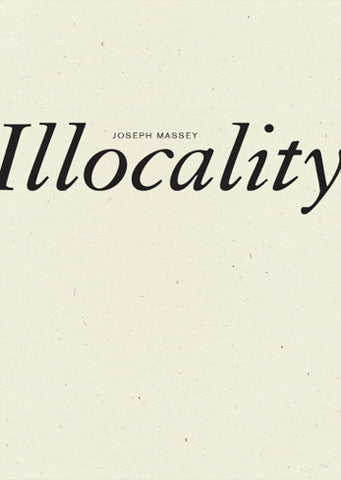
As I’m sure anyone who reads this blog knows, I’m in the midst of a 10 week (annual!) poetry course being held at the UPenn on Modern and Contemporary American Poetry.  One of the many things I like about the course is how different it is each year.  This year is particularly fresh, with a lot of material I haven’t come across before, including, to my delight, the work of Joseph Massey, whose book Illocality is on its way to me now from the US.  The poem that really got to me was "Polar Low”, and rather than try to summarise it, I’ve put the text of my essay on this poem below, not only because it covers what I want to say about the sparse complexity of this poem, but also because it provides an example of a close reading of a poem - the sort of thing I tend to do when reviewing a book (and why I’m continually drawn to reviewing, and the way it forces me to take time).

I've found a full text version of of this lovely poem here: http://robmclennan.blogspot.com.au/2015/10/joseph-massey-illocality.html.  More on Joe Massey can be found at his website.


The nothing that is: approaching nirvana in Joseph Massey’s "Polar Low”

There’s a precision in Joseph Massey’s “Polar Low,” that owes much to the Imagist tradition.  For one thing, Massey’s “direct treatment” of the trailer is described with stark clarity. The poem could be a painting, with its single image of a “yellow double-wide trailer”.  There is “nothing else”, aside from setting: the winter sun, the snow, and the sparse vegetation. The singularity of this observation and the absence of an ‘observing self’ is pure Imagism. The contrast of the colours between the yellow trailer and the white snow becomes luxurious in such a desolate scene, calling to mind William Carlos Williams’ “The Red Wheelbarrow”.  However, there is much in this work that takes it outside of the Imagist tradition.

The colours themselves are more than what they seem. The yellow of the trailer mirrors the yellow of the winter sun, which has been anthropomorphised into amnesia, while the morning becomes inarticulate.  Suddenly the reader becomes conscious of a human presence, whose suffering (coldness/poverty), and inarticulate amnesia is suffused into the scene by reversal of the pathetic fallacy, as if the human were transforming into the sun and morning rather than the other way around.  The white of the ice sheathing the trailer mirrors, both literally in terms of the light being reflected, and metaphorically in terms of matching, the white of the snow and the implied white of emptiness (the dimming scene as the piece progresses), and perhaps the white of an unwritten page. These “variations” also contrast with the green/brown of the winter thicket, a dying remnant of spring.

Rhythm is created by repetition of sound and structure, with short couplets that don’t necessarily couple up.  The first stanza has two hyphenated constructions, which are semantically opposite—half-sheathed versus double-wide—as well as being metrically and syllabically reversed.  The word “mirrors” also becomes a connector linking the trailer with the much more abstract morning – disparate images equated.  Massey uses punctuation between stanzas to slow the reading down and force a pause for reflection at each full stop.  We stop after morning as almost a shudder in our movement across the scene, and then again after sun, so that the two phrases, “The inarticulate morning” and “The amnesiac sun” are paralleled rhythmically and semantically, creating a breathlike quality to the reading.

The next sentence begins with the conjunction “And”, the point at which the poem begins to move, the trailer receding. The repetition of sound becomes stronger here, taking on a more regular rhythm that doesn’t pause until we reach (the) “perimeter”, creating a meditative effect.  This is further heightened by the soft rhymes of thin, dim, perim-eter.  Alliteration throughout the poem also adds to the deepening of breath, with the m sound in “mirrors", “morning", “amnesiac"; the s sound in “else", “contrast", “these"; the k sound in “thicket" and “choked"; the o sound in “other" and “over"; and the n sound in “noun” and “frozen".  These sonic connections give the poem a deep unity that not only creates motion in the stillness of the scene, but also draws the reader into the inarticulateness - a meaning beyond semantics, as if all we could see is white and all we can hear is our own heartbeat. At this point, the entire poem transforms the present moment itself, rather than the trailer, into its subject, and the dissolving of those names (or “nouns”) into a kind of mindful emptiness or the realisation of non-self, and both the reader and writer’s union with the scene, as the denouement.  

Sunday, October 9, 2016

Poetry Monday (Sunday): Michele Seminara’s Engraft

I have no idea who decides on days-of-the-week things like Throwback Thurs
or Poetry Sunday.  I had just assumed it was some kind of alliterative thing, though there’s no real alliteration in Poetry Sunday.  Operating across geographical boundaries does means you can kind of double up - celebrate your birth twice without growing older, have a Poetry Sunday on Monday, and basically break any semantical rule you want on the grounds that they do it differently somewhere else.  If any day of the week is in need of a poetry injection, it’s Monday which is often sadly devoid of poetry.  So herewith is Poetry Sunday which I’ll continue to do on my Monday but which is most definitely Sunday somewhere else in the world (North America for example).

I've been immersed in Gertrude Stein’s Tender Buttons for ModPo, and have been loving it as always, but reading Stein is never relaxing for me.  I always have to work with it.  It’s tiring.  Michele Seminara’s Engraft is beautifully written poetry, smart, elegant and in many ways post-modern, conceptualist and rich, but it’s not hard work.  The poems are immediately familiar to me in terms of their landscapes, and the domestic sensibility of their concerns: love, loss, aging, death, illness, motherhood, and literary intertextuality all presented lightly, and sometimes with humour, even at its darkest.  I have only read through the book once, and usually read through several times before writing a full review, but by way of a taster, here’s a snippet of one of the poems that hit me immediately:
How is it that we came to be locked
in these bodies, lives ossifying
not rights of fat, rigidity and suffering?That man was once a boy
light as a dandelion, the body
barely given thought. 
Now it’s a trap, and death the escape.
The doctor says my oestrogen is low.
She prescribes hormone to alter
the cruelty of my vision. (“Zhuang Zhou Dreams in Pink”)
Full review will follow at Compulsive Reader soon, but if you can’t wait, the book can be purchased in both hard copy and ebook form at Michele Seminara’s blog here: https://micheleseminara.wordpress.com
or from the publisher here: http://islandpress.tripod.com/ISLAND.htm or at Michele Seminara’s blog:

Monday, August 22, 2016

Poetry Monday: Michel Faber’s Undying

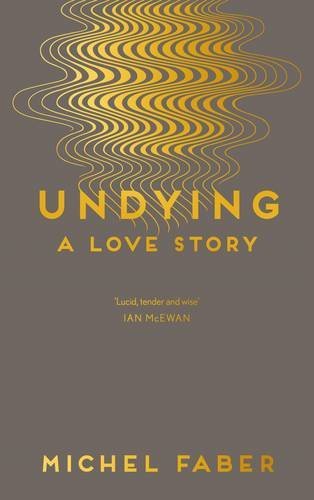
I was working on a novel that seemed to be progressing well - right through my mother’s illness - writing chapters on the airplane, in the hospital after her kidney was removed, or at her house late at night through a jet lag haze in between taking her to the bathroom. But once my mother died, I couldn’t write prose anymore.  It seemed wrong: inappropriately linear; too beholden to cause and effect.  Only poetry worked for me, and poetry was a lifeline - a way to inhabit the entirely new space of grief and explore the complexity of the pain I was feeling. So I understand Faber’s move away from fiction and into poetry in the wake of his wife Eva’s death.  His new book, Undying, is almost like a memoir, centred around the last few weeks of Eva’s life, through the worst of her treatment and a remission, and that terrible space of mourning in the weeks and months after Eva died.  The poetry sometimes undermines itself with little rhymes, but mostly it’s a powerful expression of Faber’s anger, grief and sense of loss as he begins to make sense of life without his wife.  I sat blubbering through the book, crying right through to the end, which is transcendent:

And it is not for me
to show you that death is not the end.
But you left lucencies of grace
secreted in the world,
still glowing.  ("Lucencies (2)")

One of the poems that hit me hardest was “Don’t Hesitate to Ask” which you can hear Faber read on ABC Adelaide: https://soundcloud.com/891-abc-adelaide/michel-faber-dont-hesitate-to-ask

By way of a taster, here is a tiny bit of it, though I urge you to listen to the whole thing: 

Well,
actually,
since you offer, 
yes: 
Would you mind driving me
headlong through the universe
at ten million miles an hour,
scattering stars like trashcans
scorching the sky?


Sunday, August 7, 2016

Poetry Monday: Round the campfire with Les Murray

Les Murray is arguably one of Australia’s best known poets.  His work sits very tidily in the gap between eco-poetics and bush-poetry, is wholly accessible, and often luminous with insight.  If ever there was a poet whose work should be recited over a campfire, it’s Les Murray’s.  Murray will be reading some of his poems to a relatively intimate gathering at the St Alban’s Writers’ Festival on Saturday the 17th of Sept around 9pm. The event is free, and I would think, the only one of its kind anywhere.  You can be part of the gathering, and many more literary events in this most intimate of literary festivals by dropping by: http://www.stalbanswritersfestival.com.au

In the meantime, here’s a sample from “Vertigo”, a poem from Murray’s latest collection Waiting for the Past.  For the full poem, just click on the title or visit: https://www.poetryfoundation.org/poetrymagazine/poems/detail/56988#poem


"Later comes the sunny day when
street detail whitens blindly to mauve

and people hurry you, or wait, quiet."


Monday, August 1, 2016

Poetry Monday: Verity La’s new poetry podcast (and Phillip Gijindarriji Hall)

Ooh I love me a good podcast. Verity La has just started up a new poetry podcast,
adding a bit of audio depth to their already wonderful free creative arts magazine. The inaugural podcast features Alice Allan interviewing Phillip Gijindarriji Hall, who talks about his time with Diwurruwurru (The Borroloola Poetry Club), and reads from his poem “Concourse for the Borroloola mob”:


"true god, we really are an arterial kaleidoscope
                                  of silt-laden language." 
Hall also reads one of his favourite poems, Dorothy Hewett’s “Inheritance
“I have travelled a long way from my origins...”  

If you’re not familiar with Verity La, you should be. Managing Editor Michele Seminara does a wonderful job, is warm and inclusive, and the journal publishes a new (free) creative piece each week, including lots of poetry, and is always stimulating, fresh, and exciting.

To listen to or download the 30 min podcast, drop by here:
http://verityla.com/the-verity-la-poetry-podcast/

Monday, July 11, 2016

Poetry Monday: Joel Deane’s Year of the Wasp

I’ve just finished my first (and definitely not my last) reading of Joel Deane’s Year of the Wasp.  I’ll be writing a much longer review shortly, but can’t wait to talk about it.  The book is relatively short at 55 pages, but is dense, rich, intense.  The poems focus around the central theme of aphasia: Joel’s 2012 stroke and his struggle not only to renegotiate his language but to reevaluate the world and what it means to make sense in the aftermath.  The result is stunning, moving imperceptibly between the personal and the political, and creating new meaning in the gaps between language and sensation:
                 Night rain sweeps
from the west,
wearing a slip
                of silken smoke
                                   to mask memories.
For more, you can read three excerpts from Year of the Wasp at Verity La:
http://verityla.com/poems-from-year-of-the-wasp-joel-deane/.  Joel and I will be chatting on air early next month at Compulsive Reader Talks.


Monday, June 20, 2016

Poetry Monday: Hazel Smith’s Word Migrants

I’ve just started reading Hazel Smith’s Word Migrants and am already hooked by the richness of the poetry’s presentation: performative modernity coupled with an almost painful intimacy:
Before you disappeared my aloneness was the vibrations of a coastline, I could feel the pitches of the waves beneath my feet. Now the soles of my feet sink into the sand.  And it sticks. (“The Disappeared”)

Smith's The Writing Experiment is one of the best writing manuals available for teaching writers the techniques of experimentation (I use it regularly), and it’s fascinating to see some of those principles in play in Smith’s own poetry as she explores topical issues include the refugee crisis, climate change, political and social abuses, aging, grief, and the nature of privilege and power.

The poems I’ve read so far maintain a lovely delicacy, drawing the reader into worlds which are often dystopian (all too real at times), but also playful, experimental, enlivened by sound and an awareness of the space on the page, exploring the nature of language, semantics, referentiality, and genre, without ever losing their immediacy, contextual relevancy, or coherence.  Here’s another little sample:
Every conversation is a gentle misfiring
   An abacus points beyond method or counting
      An exchange derails, eyes averted, glancing (“Encounter”)
I’ll be reading more deeply over the next week or so and will follow with a full review at Compulsive Reader.  In the meantime, you can found out more about Hazel Smith here: http://www.australysis.com

Sunday, May 29, 2016

Poetry Monday: Poetry Magazine’s Australian issue

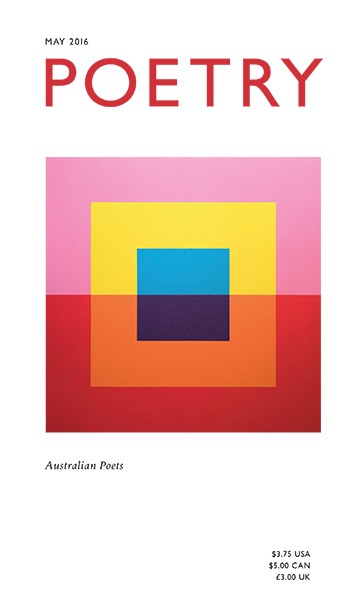
This is a bit late, as I decided to write about the May issue of Poetry Magazine some weeks ago and got waylaid by a few other literary activities.  This month’s issue was guest edited by Robert Adamson, one of Australia’s best known contemporary poets, and features beautiful portraits from Juno Gemes.  If you aren’t already familiar with the fresh, often beautiful, sometimes shockingly uncomfortable poetry being produced from Australian writers at the moment, this issue is an excellent place to start, as it features the work of some of the most innovative and powerful poets writing today including Bonny Cassidy, Ali Cobby Eckermann, Jaya Savige, Gig Ryan, Robbie Coburn, Luke Davies, Lisa Gorton, Anthony Lawrence, and many others.  If you are already familiar, then you’ll know this issue is a massive treat, full of rich and powerful work.  But don’t take my word for it.  Drop over the website and listen to the podcast, which includes poets like Lionel Fogerty, Jaya Savige and Ali Cobby Eckermann reading from their own work in a way that adds a great deal of depth to the poems.  There’s not a single poem in this collection which isn’t exquisite and moving.  Some, like Luke Davies’ "Heisenberg Saying Goodbye to Mum at Lilyfield”, or Lisa Gorton’s “Empirical IV” left me struggling to swallow from the lump in my throat.  But to pick and choose a few poems to highlight would not be appropriate.  Every single one of these poems deserves to be read slowly, savoured and pondered.  Adamson has done a superb job with his selections.  Podcast is here: http://www.poetryfoundation.org/poetrymagazine

You can also check out each poem via the table of contents or subscribe here: http://www.poetryfoundation.org/poetrymagazine/toc/detail/88998


Monday, March 21, 2016

Poetry Monday: World Poetry Day + Eileen Myles Live

Happy world poetry day.  The United Nations Educational, Scientific and Cultural Organization (UNESCO) made the decision to proclaim today as World Poetry during UNESCO’s 30th session held in Paris in 1999.  One of the main objectives of the Day is to support linguistic diversity through poetic expression and to offer endangered languages the opportunity to be heard within their communities.

Photo by Catherine Opie

From UNESCO’s website: "Poetry reaffirms our common humanity by revealing to us that individuals, everywhere in the world, share the same questions and feelings.”  I couldn’t agree more.  So why not take the opportunity to celebrate?  The Academy of American Poets has put together a list of links to poetry organisations and festivals around the world, that you can explore - each has lots of resources.  You could take one of your poems and trade it for a cup of coffee or tea courtesy of Julius Meinl coffee: http://www.meinlcoffee.com/paywithapoem.  You could spend far too long perusing the many quotes, images and events on Twitter.  You could drop by UNESCO’s page which has lots of background material and some featured poets.  You could buy someone (yourself, perhaps) a book of poetry from a local bookstore (or order one up from the library - bonus points if it’s a poet who lives in your city).  You could read one of your favourite poems, aloud, to the delight of all your family (mine certainly enjoys it when I do that, not, but it generally doesn’t stop me :-).  Or, you could enjoy two "Writers House Fellows" events featuring none other than Eileen Myles.  These will be streamed live through KWH-TV at http://writing.upenn.edu/wh/multimedia/tv/.  The first is on the 21st of March (probably today for most of you) at 6:30 PM US eastern time (9:30 AM AU EST if you happen to be on my timezone) and will feature Eileen reading her work.  The second is an interview/conversation on Tuesday, March 22, starting at 10:30 AM US eastern time. Apparently you’re invited!


Monday, February 29, 2016

Poetry Monday: Jane Hirshfield’s February 29th

How could I pass up the opportunity to pass on Jane Hirshfield’s “February 29th” which is Poets.org’s (aka The Academy of American Poets) Poem-of-the-Day.  The poem comes from her newest book The Beauty and the full text can be found right here: https://www.poets.org/poetsorg/poem/february-29, and while  you’re there, you can sign up for their fantastic service, which provides, entirely free-of-charge, a poem into your in-box each day.  I like to end my day with them.  Just one poem to go to bed with.  One poem to cogitate upon.  I don’t like every poem that comes, but I like a lot of them, and I love some of them.  There’s always time to read one poem more.  Here’s a single stanza by way of a taste (but you should really read the whole thing - there’s time for it today).  Happy leap year.

An extra day—
Not unlike the space
between a door and its frame
when one room is lit and another is not,
and one changes into the other
as a woman exchanges a scarf.

Monday, February 8, 2016

Poetry Monday: Justin Lowe’s Nightswim

have to admit that an electronic copy of Nightswim has been sitting on my laptop for many months now, patiently awaiting my much distracted attention.  Author Justin Lowe runs the phenomenal poetry site Bluepepper and has become something of a cornerstone in Australian poetry as both poet and publisher. The poems in his 6th collection, Nightswim, cover a lot of ground - from notions of home, aging, death, ghosts (a recurring theme), travel, the nature and power of poetry, poems of place, of the environment, loss, an ode to other poets, and above all, love.  Many of the poems in this collection are about love, and not just eros, but also Philia or friendship, Ludus or playful love, and Agape or selfless love.  Full review to follow now that I’ve charged up the Kindle, but in the meantime, here’s a little taste - just a few stanzas from “Vallejo”:

I have spoken to the ghosts:
they are clear on my predicament

coming in out of the sun
into the cool, dark void,

I glimpse them briefly
hunched around my table,

dabbing at crumbs
that will not rise to their lips.

If you want more, autographed copies of the book (which could be a perfect valentines day gift if you’re struggling) are available directly from: http://www.thecarnivalbookstore.blogspot.com.au

Sunday, January 24, 2016

Poetry Monday: PoemTalk does Allen R Grossman’s My Radiant Eye

I’ve said this before and will no doubt say it again, but Jacket2’s PoemTalk is my favourite podcast.  I  try to listen to every show, not just to discover a new poet, but to listen to the way in which poetry - even poetry that seems cryptic and confusing at first, can be explored, unpicked, and opened out towards its full beauty.  In this issue the team, consisting of Kathryn Hellerstein, Peter Cole, Ariel Resnikoff, and of course, Al Filreis, who drives the discussion, looks at Allen R Grossman’s poem “My Radiant Eye”.  The discussion is informative, including ancillary but relevant information (the “inter text”) to both the poem itself, and to Grossman and the book that contains it, Descartes’ Loneliness, as well as an analysis of many aspects of the poem - its resonances, its “way of seeing”, the meta-poetic elements of the piece, the  and the revelations.  I think it was Cole who said:  [This is] “a poem of retrospection...a eulogy for the lone poet.  The theatre of the absurd within the drama of the poem  is what redeems the impossible situation the he finds himself in.”

You can listen to the episode of PoemTalk here: https://jacket2.org/podcasts/laurel-crown-poemtalk-96

The full text of My Radiant Eye can be found at Google Books.  Here’s a taste:

Or is it on account of my radiant eye
I have lived so long--I never slept

in the study hall, or called anyone
by an improper name. I never urinated in

a desolate synagogue.  I never ate or drink
in a desolate synagogue or picked my teeth.

Monday, January 18, 2016

Poetry Monday: Imperfect Echoes by Carolyn Howard-Johnson

For Poetry Monday this week I’m going to give a shout-out to my writing buddy Carolyn Howard-Johnson, who has a relatively new poetry book out called Imperfect Echoes: Writing Truth and Justice with Capital Letters, lie and oppression with Small. The book includes a few reprints from our Celebration Series collaborations, and is beautifully illustrated with images by Richard Conway Jackson, who is currently in prison in California.  All proceeds from the book are being donated to Amnesty International.  The book was inspired by Czeslaw Milosz' The Captive Mind and includes a range of poems focused around the utterly relevant topics of Peace, Tolerance, Hope, Truth, Justice, and Acceptance (note the capital letters).  Carolyn’s poems, as always, manage the delicate balance between easy accessibility, and deep complexity as they explore big concepts through everyday events.  Here’s a sample from the last poem in the book "Interpreting Fairy Tales"

From That to This,
the connection.
How what I didn’t know
and how the knowing 
changes things. Riotous 
orchids, baa baa black sheep,
ugly ducklings. Here, a single
troll waits under a bridge.

His name is Time.

Monday, January 11, 2016

Poetry Monday: Eileen Myles' School of Fish

I’ve been participating in an Eileen Myles poetry discussion group (kind of an offshoot from the marvellous ModPo course which I, um, might have mentioned a few times) in which we read and discuss one poem every few days (sometimes every day).  I’ve enjoyed every poem we’ve discussed, and if you haven’t heard of Eileen Myles, who has suddenly become something of a poetic superstar, I have to recommend her to you.  So far my favourite is the title poem from Myles’ School of Fish (Black Sparrow Books, 1997), a poem which was recently featured in the series Transparent, in which Cherry Jones plays a character loosely based on Myles. There’s something so liquid and rich about this poem - the way it explores homelessness in such a personal and even subtle way, while also going deep into notions of the self and belonging (without leaving out her dog).  Here’s the last part of it:

the deeper and deeper we go and the harder
it is to turn the key and eventually we
go and it is very very dark
we just get used to the light
but the blues and the greys and the feelings
of lostness, it's like home, it's like family.

The entire poem can be found here: http://awp.diaart.org/poetry/96_97/myles.html
or you can listen to Myles’ own rather intimate reading here: http://www.eileenmyles.com/mp3s/Myles-Eileen_07_School-of-Fish_Close-Listening_3-24-09.mp3

(and yes I know it’s Tuesday, but it might still be Monday where you are...or when you get here)


Sunday, January 3, 2016

Poetry Monday: PoemTalk95: Robert Fitterman’s Sprawl

It has taken me a while to catch up on PoemTalk - one of my favourite podcasts.  There hasn’t been a single episode that I haven’t enjoyed - I really liked the previous episode 94, which explored two poems from CA Conrad’s ‘(Soma)tic Midge’.  But since we’re already in January, I thought I’d share the latest episode, which is an exploration of five sections from Robert Fitterman’s book Sprawl published by Make Now Press in 2010.  All of the pieces explored are actually available in the Penn Sound archives so if you go to the PoemTalk link here: http://jacket2.org/podcasts/i-too-received-identity-poemtalk-95 you can listen to the episode (which also contains Fitterman’s readings) or listen to the individual poems read aloud.  These poems aren’t what you’d call lovely.  They’re kind of mock-consumerist, full of sound-bites, and familiar enough to be uncomfortable for the listener.  They’re full of vernacular voices, opinions, commentary at the shopping mall, on social media, or private conversations.  Fitterman’s reading, which is funny, sound almost like a comedy skit by Steve Wright.  Rodrigo Toscano likens Fitterman’s mall to Dante’s rings of hell, and if you’ve recently been shopping in a mall, you might agree (I might have made that comparison myself last time I was at Westfield).  PoemTalk’s very intelligent group featuring Al Filreis (as always), Michelle Taransky, Rodrigo Tuscan, and Laynie Browne suggest other possibilities in the work: the mapping of consumer culture as an archeology condensed to existentialist profundity.  Is that going too far?  I’m not sure, but I enjoyed their exploration very much, and as always, this podcast continues to teach me new ways to approach difficult or heavily conceptual poetry with an open mind and a multitude of possibilities.  Check it out and let me know what you think.  

Monday, November 30, 2015

Poetry Monday: Anna Kerdijk Nicholson’s Everyday Epic

I’ve always thought that legal language and poetry were somewhat inimical to one another. Legal language is all about exactness, authority, and the weight of historical context. There’s no place for imagery, co-existance of multiple meanings, and vagaries.  Instead legal language tends towards the use of precise technical terms with Latin roots, phrasal verbs, and pronominal adverbs, none of which tend to work so well in poetry. Anna Kerdijk Nicholson is a rare blend of lawyer and poet, making full use of her awareness of language and it’s real-life importance, but allowing the full multiplicity of poetry’s linguistic and demilitarisation qualities to shine in her poetic work.  Kerdijk Nicholason makes full use of her linguistic skills in her new book Everyday Epic, exploring globally relevant current affairs and domestic scenes with the subtlety and complexity of a poet’s awareness of the difficulty of communication and the need for multiplicity in meanings.  Everyday Epic explores both the grand events of history such as the not-so-everyday epic of Burke & Wills, immigration, current affairs, but also a number of poems that explore cross-media including ekphrasis, love, grief, the beauty and occasional terror of the domestic front, and perhaps above all, the nature of language - its limits, its potential, its rhythms, and the way we can create new spaces through it.  For example,
this little taster from the poem "Although,”:
I step on the interstices
and sing in your hollows
you resound on me
and refract
I’m in discourse
although alone
I’ve yet to fully and deeply explore this collection in the way I like to with poetry: reading and re-reading, allowing time for the work to come around with me, and permeate the way I perceive things.  I’m doing that now, and enjoying it very much.  More soon.