Showing posts with label poetry. Show all posts

Thursday, October 19, 2023

Darkinfested: sensate and visceral (on "Subliminal" by Lorine Niedecker)

This is my second ModPo 2023 essay on Lorine Niedecker's "Subliminal". I've been on quite the Niedecker kick lately and coming across this sequence, which I hadn't read before, has increased the kick.  The bit below is all I wrote the message on but I recommend the full sequence which cannot be found online (I won't paste from my book which I don't think is legal), but the book with the full sequence is Harpsichord & Salt Fish which I now have but which you could very likely get from your local library if you want to read it in full (highly recommended).  The essay specifically asked us to explore how this poem engages with the principles of Imagism. 

“Subliminal” by Lorine Niedecker is a five-poem sequence, but for the purpose of this essay I will only be close-reading the first section.  In classic Niedecker style, the poem is condensed and spare, its meaning arising as much from the structure and spaces in the work as from the semantics.  The short lines of each of the four couplets begin with two or three words indented as the first part of the couplet, describing what is mostly sensate and visceral - embodied in alliterative and sometimes sibilant sounds that evoke an immediate response in the reader. The second lines of the poem are more descriptive and slightly longer - an attempt perhaps at qualifying the sensation of the first line. For example, a reader might approach the first couplet with the question “what is Sleep’s dream” and the answer ‘a nerve-flash in the blood”.  The poems structure with those even indents create a visual impression of a double helix twist - perhaps hinting that there is something inherited here - that tall, torment of the mother, the repeated use of the word “nerve”.  

There are many elements of this extract that align with imagism.  All of the sonic and structural elements of the poem described above do seem to suggest something other than a "direct treatment of “thing,” one of Imagism’s key tenants, however it is also fair to say that the poem may well be the direct treatment of a dream, rendering the elements of the dream (rather than the mother, or the sensations themselves) in a direct way.  It is also possible to define the object as the mother, the most concrete image in the poem, rendered with a crispness as ‘tall, tormented’ both fairly straightforward words and an absence of metaphors, as is often the case with Niedecker.  I do think that would be a simplistic reading of the poem though, as there is much that could be taken as symbolic. While the poem feels internally complete and not referential and the words are, in the main, not decorative, there is that final word, ‘darkinfested’ - which comes right at the end of the extract as a portmanteau (two words combined) which wouldn’t appear in common speech that way.  Linking the deep interiority of a dream with all that sensation, and then using that final, powerful portmanteau to end the extract, gives the poem a symbolic and even surrealistic quality which hints in a very non Imagistic way, at the unconscious, and the traumas we might carry, and less about the dream itself, or even the mother who appears here as an ominous presence.  There’s a certain dynamism here that is brought in with the combination of these sensual images - the nerve-flash and cold sensation and the structure of the helix which suggests inheritance, along with the seductive, sibilant musicality of the sound.  While it is true that Imagism seeks new rhythms, there is, in this condensation, much in the way of symbolic and intense power not in keeping with the fixed object of an Imagistic approach but rather much more open, and subject to multiple interpretations, readings and ways of experiencing.  


Saturday, December 4, 2021

Two wonderful new reviews

As a writer, you can go months of working into what feels like a void.  Of course you have supportive writers' groups, wonderful friends to talk about your work with, public readings, etc, and you will say that external validation doesn't matter - it's all about the practice, which is good advice and mostly you mean it, but the truth is that external validation, at least here and there, is incredibly important. I'm a reviewer myself, so I know the joy of engaging deeply with a book from the point of view of a reader. I feel like every review I write is a gift to myself: the gift of time, of attention, of allowing myself to open to something new.  But it's easy to forget how much of an impact a deeply considered, beautifully written review can have on the author. It's not just that reviews are great for promoting your work. For me that is absolutely secondary.  Knowing that someone you respect not only understands the work, but makes new connections in ways you could never have anticipated when you were working on it, is enough to keep me working for many more months into the void.  

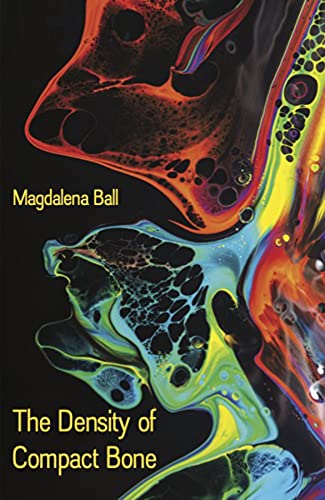
So it is with a great deal of joy that I received two beautiful reviews for my new poetry book The Density of Compact Bone today.  The first was from Charles Rammelkamp for international "cultural omnibus" London Grip: "Time is both an abstract concept and a monolithic force. It’s behind extinction, annihilation, memory, age. It’s also an illusion."  The full review can be read here: https://londongrip.co.uk/2021/12/london-grip-poetry-review-magdalena-ball/

The second was from the Beatriz Copello at the Australian powerhouse Rochford Street Review: "The Density of Compact Boneis divided into four sections, each opens a door to different worlds, different spaces, moving from the microcosm to the macrocosm, from the individual to the multitudes, all written with richness of language and impeccable penmanship, or should I say penwomanship?" The full review can be found here: https://rochfordstreetreview.com/2021/12/04/22530/

Both reviews are beautifully written and deeply considered and I feel so grateful for the attention this little book has received from these generous and intelligent souls.  

Tuesday, November 2, 2021

Density of Compact Bone is now Available!

My new poetry book Density of Compact Bone is now available from Ginninderra Press (and good bookstores everywhere - just ask for it, or ask your local library to get it in).  Of the book, the wonderful Ivy Ireland says:

“The poems of Magdalena Ball’s The Density of Compact Bone are utterly visceral, sometimes temporal, but never quite ephemeral – lines will ring out in waves inside the mind long after the final page has been turned. These poems are not only haunting, but haunted: by the sense of something undetermined gone missing and also by what is known to be lost. These are poems explored through the body; internal, intimate and yet filled with paradigmatic shifts: from personal grief to global keening, from the blurred landscape of raw human feeling to the clear data of exacting scientific analysis. Apocalypse is rife here, but this collection moves beyond a dissection of our end times. These poems are intelligent – at times almost mordantly so – meticulously crafted and ontologically restless, yet somehow Ball’s humour, unassuming warmth, and varied musings on the movement of birds, the colour of planets or the buzzing of bees, leaves the reader feeling as though they have been gifted a potent balm for the relentless wounding ubiquitous here in the Anthropocene.”

To purchase, visit Ginninderra Press: https://www.ginninderrapress.com.au/store.php?product/page/2354/Magdalena+Ball+%2F+The+Density+of+Compact+Bone

Or from Amazon: https://www.amazon.com/Density-Compact-Bone-Magdalena-Ball/dp/1761091867/ref=tmm_pap_swatch_0?_encoding=UTF8&qid=&sr=

Both hard copies and ebooks available.  If you are a reviewer, journalist, educator or run a book club and want me to talk or read (free), please contact me. 

Wednesday, April 14, 2021

Guest Blog: A Birthday Wish for the National Poetry Month


Guest blog by Nina Murray: A Birthday Wish for the National Poetry Month

My birthday falls during the National Poetry Month in the US. I also happen to be a poet, so when people send me texts, presents, and other nice things for my birthday, I feel like poetry and poets ought to get some of the glow of the attention in which I bask. So this year, I asked my faithful Instagram followers and friends to make it a #helpoutapoet day and post a review of a poetry book they’ve read. The National Endowment for the Arts found that poetry readership doubled between 2013 and 2018 to a total of 28 million adults, news that was hailed as “dramatic.” The surveys used in the study that produced this number did not differentiate between having read a poem or a book of poetry.  

The Sealey Challenge arrived in 2017, and poets rejoiced again. After all, if people commit to reading 31 books of poetry in 31 days, that ought to do wonders for the art form. The challenge is a beautiful, spontaneous, powerful thing. It is also very hard, and I don’t even dare take it on. I only read half a dozen poetry collections last year. I reviewed all of them—on blogs, for literary journals, and on Goodreads and Amazon. This is my commitment: to review every book of poetry I read. Here’s why. 

Americans, despite the hand-wringing we have all heard, are still reading, and the COVID-19 occasioned lockdown is likely to boost the numbers of books read per person. What they are reading is a bit harder to pin down. The Census Bureau and the National Endowment for the Arts have been tracking reading trends since 1982. Back then, 56.9 percent of respondents said they had read a work of “creative literature” in the previous twelve months. In 2002, that figure fell to 46.7. In 2017, the most recent data available, 57 percent reported they “read books not required for work or school,” but only 42 percent specifically reported reading “novels or short stories”.  Of the millions of books published in the US each year, most that make it into the hands of the readers fall into mystery/thriller and romance categories. When Publishers Weekly did the math for 2020, they found that four out of top-ten selling titles were fiction. 

Before a book ever makes it onto a Barnes&Noble shelf with a glossy cover and a hefty price tag, it has to be sold six times, literally and figuratively. The author has to sell the manuscript to the agent. The agent has to sell it to the publisher, specifically, to the acquisitions editor. If the acquisitions editor has to get an editorial board’s approval, that’s three. Four: the acquisitions talks up the book to the marketing department. Five: marketing goes on the road to sell books to the wholesalers or reps. Six: the buyers at Barnes&Noble “sell” the book to the merchandisers who decide where in the store it goes, whether it gets a separate display, whether it is allowed to be placed flat on the shelf or just slipped, spine out, between its fellows. By the time you, dear reader, come into the bookstore with your preciously limited disposable income ($24.95 per year per “consumer unit” in 2019, which buys you one hardcover edition) a large group of professionals has labored for months to ensure that your judgement of their product is quick (because, after all, your attention span is shortened by all that visual media you consume) and positive. 

In the scrappy world of independent authors (previously known as self-publishing), the game is all about the numbers because that’s what algorithms understand. Instead of sending hundreds of queries to literary agents or publishers, the author recruits beta-readers. The author sets a release date and distributes advance copy to more readers, of whom at least a few, one hopes, have high visibility to Amazon. The author, inevitably, gets spam-sounding emails from people who offer to read and review his/her book for a small fee. There are give-aways to manage. Ad campaigns to design. The Eye of Sauron... I mean, the Amazon algorithm to catch. 

Let’s take a closer look. 

The author wrote a query letter to the agent (‘the pitch’). The author chose carefully and wrote to the agent who specializes in the kind of book the author has written. Since the author did his/her homework, the agent considered the manuscript carefully, and if it fit with what the agent usually represents and was  a competent piece of craftsmanship, the agent took it on and eventually called an editor. Obviously, the agent didn’t call just any editor – he/she has done her homework too, and only calls editors who publish the kind of books the agent represents. The editor wrote an internal memo to the board or to the marketing department. In it, he/she certainly mentioned how the book fits with the existing list of previously published titles. 

On the basis of these, marketing wrote the back-cover blurb. The author suggested other authors who might provide “advance praise”. Marketing also zeroed in on the keywords under which the book is catalogued in the Library of Congress and on bookstore shelves: Fiction—Women—Pregnancy. Or, Omaha, NE—Fiction. These categories help retailers categorize those millions of books that come to them each year; it is understandable that one would want them to be as narrow as possible, to minimize competition in each niche. Also, when you are looking for that belated gift for your 12-year-old niece who loves sharks, they save the day: Marine life—Pre-teen—Non-fiction. Done.

What all this preparation, all these keywords, blurbs and advance praises will never tell you, is whether the book you are holding in your hands is about to change your world. They won’t tell you if you’re holding a masterpiece, the defining work of our times, the next great one. They can’t. The number of titles published every year is growing, and the portion of the disposable income spent on books is falling. The resources required to attract your, dear reader, attention to a particular book far outweigh those necessary to produce it. The result is further compartmentalization of the supply. This means, basically, that editors and agents are narrowing their areas of acquisition, just as bookstores are fitting more keywords onto a single shelf, and Amazon’s algorithms try to match your reading preference to your choice of color for the bath towels. 

A medium-sized publishing house may not consider any fiction other than novels set in a particular region, such as the Midwest. Should one of them  happen to be the next literary revolution, its success will still depend on the amount of resources the marketing department can throw behind it, and those resources are always limited—at smaller presses, there simply isn’t that much money to go around, and at the bigger presses the cost of the author’s advance can swallow a big chunk of a book’s budget.

How, then, are we readers to choose the books we buy in search of inspiration, enlightenment, or simply entertainment? How do we know we are not wasting our $24.95? Or even $2.95 for a Kindle edition? 

If it’s money you are worried about, the answer is easy: public libraries are excellent, thrift stores are awash in well- and less-known gems, and Little Free Libraries are adorable. 

If, however, you would like to know what you should read next, for reasons of emotional, dramatic, or comic power, you might be at sea. You might—and very well should—turn to places that publish reviews (and I don’t mean Goodreads). In the interest of cutting costs, newspapers across the country have cut book review staff and discontinued relationships with free-lance writers. One no longer has the luxury of making a living as a literary critic (remember those?).  Reviewers are volunteers, and just like other volunteers they do this work because they believe in it. They believe that when they sit down with a book, read it with an open mind, and give you their honest opinion, they do something that no one else will. 


About the author: Nina Murray, poet, translator

Nina Murray was born and raised in the Western Ukrainian city of Lviv.  She holds advanced degrees in linguistics and creative writing.  She is the author of the poetry collection Alcestis in the Underworld (Circling Rivers Press, 2019) as well as chapbooks Minimize Considered (Finishing Line Press, 2018), Minor Heresies (Heartland Review Press, 2020), and Damascus Electric (Pen & Anvil Press, 2020).  Her translations from Russian and Ukrainian include Peter Aleshkovsky's Stargorod, Oksana Zabuzhko's Museum of Abandoned Secrets, and Oksana Lutsyshyna's Ivan and Phoebe (forthcoming from Deep Vellum).  

She speaks Russian, Ukrainian, Spanish, Lithuanian, and English. 

Thursday, September 24, 2020

ModPo 2020 Analysis: The Poets Light But Lamps by Emily Dickinson


It's ModPo time again!  I've participated in the, by now famous, Modern and Contemporary Poetry (“ModPo”) course since it began in 2012.  Every year is different, informed by the many changes in our lives, in the world, and in the overall material that comprises the course, which are ever expanding. One of the many things I like is how the essay subjects continue to change, so that there are new poems to dive into. This year, the Emily Dickinson poem is number 930, "The Poets light but Lamps".  My essay follows.  If you haven't joined ModPo, I heartily recommend it.  It's free, there are no constraints (you can do as much or as little as you want - now, or throughout the year), it's open to all levels, and it's very engaging!  

The Poets light but Lamps--
Themselves — go out —
The Wicks they stimulate
If vital Light

Inhere as do the Suns —
Each Age a Lens
Disseminating their
Circumference —

“The Poets light but Lamps” is one of Dickinson’s shorter poems - with just two quatrains of no more than 5 words per line with a very regular syllabic structure of 6/4/6/4 for each of the quatrains. There is no punctuation other than the em(ily) dash which adds space without slowing the reading down, thereby energising the piece, as it draws the eye forward. The poem ends with the dash, which, except in the work of Dickinson, is rarely used for the ending of something, and hints at the ongoing nature of the work - visually indicating that this is not an ending as such, but something that will continue - poetry being immortal. 

The dash also provides a visual representation of a wick, thereby picking up the “Wick” in the third line, stimulated by the Poet’s light - or the light of poetry. Unusually for Dickinson, the first word of each line is capitalised. Assuming this was Dickinson's intention rather than the work of an overzealous editor, this creates a regularity that is also strengthened by capitalisation's emphasis as it creates a mirroring of "The Poets" with "The Wicks". There is also an alliteration between "If" and "Inhere", thereby linking lamplight with sunlight. The poem utilises an extended metaphor conflating the work of the poet (a lamplighter stimulating a wick - perhaps the impetus for the poem) with the Sun itself - or Suns (?) - some broader category of star shine than simply our own Sol. 

Three words stand out for the number of syllables they contain and seem to connect to one another: stimulate, Disseminating, and Circumference. Though there are all quite different words, without too much in common other than the scientific quality and the multisyllabic sound, but they also provide a sense of sonic expensiveness, as if the very nature of these longer words were able to extend the reach of the poet - moving outwards from the point of stimulation in an expansionary way, spreading outside of the circle of life. You could almost visualise the light (of poetry) spreading in that way through through the work and outwards from it. 

“Inhere” is an unusual word which means “to exist essentially or permanently in”, as in inherent. It’s possible to read the first line of the second stanza as relating to the vital light of poetry as being part and parcel of what we need to survive - as life-giving and in need of dissemination by each age. The one word which doesn’t quite fit semantically is “If” which is a point of uncertainty in the overall piece adding in a condition that could undermine the work’s thesis. If the light is not vital then perhaps there is no immortality - perhaps only some poetry is vital and work that is not vital can be forgotten. Or, it may be that the condition is one that sits with the reader. ‘If’ the reader judges the work as vital, then there is a mandate to disseminate the poetry for the sake of humanity, vital poetry being as necessary to life as sunlight, against the ephemeral darkness of each age’s fashion.

Thursday, February 13, 2020

Festival Season: IF Festival in Maitland

We’re nearly in that lovely time of year when literary festivals abound. Are there too many? Nah. The questions we’re discussing in these festivals and the ongoing collaboration between readers and writers is more critical than ever. I’ve got three festivals in a row where I’m involved in panels, as moderator and presenter.
The kick off is the inaugural Indie Festival (IF) in Maitland: https://ifmaitland.org  All of the panels are completely free!  There are also a range of excellent workshops (not free but very inexpensive), and keynotes (also free). My sessions are on Saturday the 29th of February.

 I’m starting the day with the aptly titled The Importance of Regional Writers Festivals, moderated by David Graham. Joining me on the panel will be Creative Kids Tales’ Georgie Donaghey, UQld’s Dr Kim Wilkins and UMelbourne’s Dr Beth Driscoll, both highly respected, multi-published academics who are working together on the project Genre Worlds: Australian Popular Fiction in the Twenty-First Century. This session is going to be a cracker opening to the day. The session is followed by a series of Flying Island pocket book launches led by Flying Island’s very erudite Editor-in-Chief (who is launching his own new book on the day) including Michael Crane, Susan Fealy, Clark Gormley, Geoff Page, Kerri Shying, Melinda Smith, Gillian Swain, and George Watt. What a line-up! I’ll be personally launching both Melinda and Gillian’s new books and what an honour that is. My next session is called Just Walking the Dog, which I’ll be moderating, featuring poets Gillian Swain and Brian Purcell. We’ll be exploring the development of poems from initial idea through to release into the world and judging from our initial interactions, this is going to be an incredible conversation, full of fun and insights. Finally, phew, I’ll be moderating a panel on Independent and Community Publishing with Kit Kelen, Georgie Donaghey, and Jennifer Sharpe from Daisy Lane Studios about the different pathways to getting published independently. Come and learn from the best! Once again, all of these sessions are absolutely free of charge (but first in best dressed, so get in early), and there will always be time at the end for questions and audience interaction - you are the most essential part of this! So if you’re able, please come join me on the day - that’s Saturday February 29th around 230 High Street (there are a few venues), Maitland NSW.

Sunday, October 13, 2019

Poem (As the cat)

We’re just beginning week 6 (the beats!) of the wonderful annual 10 week session on modern experimental US poetry (ModPo).  William Carlos Williams (affectionately known as WCW) is actually covered in  week 3 and though I feel like I have an intimate knowledge of WCW’s work, once again, ModPo has given me a poem to work with that I’ve not read before: “Poem (As the cat)”.  We wrote our second essays in week 4, and critiqued others (a pleasurable activity that always yields new insights) through week 5. The full text of the poem follows:

As the cat
climbed over
the top of


the jamcloset
first the right
forefoot


carefully
then the hind
stepped down


into the pit of
the empty
flowerpot


Here’s my essay :-)

William Carlos Williams’ (WCW) “As the cat” takes the form of a single sentence. The poem follows the progression of a cat as it climbs over a cupboard into an empty flowerpot. The poem uses simple prosaic language, and creates a clear visual. The poem is spare in form, and free of extraneous words, however, this is not a static poem, and there are subtle, but deliberate choices that open the poem to interpretations that belie its apparent simplicity.


“As the cat” is structured to flow in soft, cat-like steps of 3 and 4 syllable lines. This is a cat on the move. The poem opens with the word “As”, which appears to be a conjunction, implying that something additional is happening concurrently with the cat’s descent, though there is nothing provided for comparison. “Then” is the natural companion to “As”, providing the poem’s turn in the moment when the cat changes direction from up to down, almost in a breathlike motion: the stepping up being an inward breath and the stepping down being exhalation.


Many of WCW’s word choices are unusual. This is not any cat but “the cat”. This implies intimacy with the reader. We are meant to know that this is a particular cat, most likely one that belongs to the speaker. It could be a metaphorical or real cat, but it is a cat with agency. It takes the deliberate action of climbing, which involve effort, then it steps down, another act of effort. No human involvement is happening here, other than in the observation, which creates an observer effect, fixing the cat in its motion or arc: deliberately moving over and then down. The jamcloset hints at a similar type of industry, that of jam-making (plum jam perhaps?), though we have no indication whether the closet is full or empty, though we know it must have contained jam because otherwise it would not be called a jamcloset – an unusual word that in assuming the reader will understand, also creates intimacy.


The word “pit” is also unusual here. Flowerpots are normally not excessively deep, and to call their interior a “pit”, particularly in conjunction with “empty” implies a kind of meaninglessness. This is more than just a visual image, but rather it’s an image of desolation that hints at death. There is a sense in the construction of this poem that by fixing the cat in this Sisyphean activity of climbing over the jamcloset and into the flowerpot, we are in fact keeping the cat in this state of agency, and thereby somehow cheating death. Of course the poem leaves this kind of extended interpretation solely to the reader. It merely provides a series of steps, rhythms, particular word choices, and the image itself, but by focusing such intense concentration on a single, ordinary, moment in time, the nature of that concentration creates this transcendence. This seems to me to be the very essence of the Imagist ideal.


Saturday, September 28, 2019

This Is My Letter To The World

It’s ModPo time!  This is the 7th year I’m dipping into the fabulous 10 week MOOC (Massive Open Online Course) on modern experimental US poetry.  Emily Dickinson is kind of like the course mascot. It begins with her and she is referenced (along with her partner-in-crime and opposite from a Yin Yang point of view, Walt Whitman) throughout the course.  The course always has new material and is always fresh and a little different but every year we are encouraged (it’s always optional, like everything in this exceptional course) to write and comment on four essays through the 10 weeks of the course.  The first is always a close reading of an Emily Dickinson poem.  This year’s is a poem that I haven’t read before (Dickinson’s output is pretty extensive for someone who never published during her life) ostensibly titled “This Is My Letter To The World”.  The full text of the poem is:
This is my letter to the world,
That never wrote to me,--
The simple news that Nature told,
With tender majesty.
Her message is committed
To hands I cannot see;
For love of her, sweet countrymen,
Judge tenderly of me! 
Following is my close reading essay.

Emily Dickinson’s “This is my letter to the World” has hints of her more famous poem “I dwell in Possibility”, with its opening word “This” conjuring “For Occupation – This–“ and the use of the word “Hands”, which are no longer “narrow”, but vast, unknown, and potentially plural. “This” refers to the poem itself – the poet's “letter to the world”, a gift to the future reader. The word that opens the poem becomes codified as “letter” which is both a metaphor for the poe, and a synecdoche for the full collected output of the poet. The use of capitalisations creates emphasis – not just on the first letter of each stanza, but of words that seem to stand on their own: “World”, “Me”, “News”, “Nature”, “Majesty”, “Message”, “Hands”, “Love”, “Her”, “Sweet”, which produces a sonic heft that adds to the power of these words and provides a focus or downward beat which overrides the iambic singsong of the more familiar rhythm of the poem.

The poem uses formal structure: an iambic metre with alternating lines of 8 and 6 syllables, two quatrains; and the rhyming of alternate stanzas: Me, Majesty and see. Although the metre doesn’t change throughout the poem, the poem is enriched by the non-rhyming lines between the rhyming ones, by the repetitions of the word “Me”, “tender” and “tenderly”, and by the rolling alliteration throughout: never/News/Nature; Me/Majesty/Message; This/That/The. Dickinson’s characteristic dashes and shortish lines give the work a forward thrust and energy, reminding us that this is a modern poem that is reaching towards the future, trusting in posterity as a means of immortality, of connection and almost mystic communication.

There is also a sense that the poem itself is a conduit for “Nature” – the “simple news”. In this sense, “This is my letter to the World” is a meta poem, about the way poetry works its magic, creating a connection between the writer and an unknown reader: “Hands I cannot see”. As readers, we are drawn into the poem as recipient, but also as the critic with the power to judge harshly. We are humbly asked to equate the poem with the natural world and possibly in the context of its time and “Judge tenderly”. The poet is being aligned with nature; a way of perceiving. The poem is therefore both intimate – a warm confidence to a single reader asked to read with empathy and care, and grand – hinting at an Ars Poetica – the justification of poetry and the power it has to transcend time and space. The poem creates a dichotomy between male (the reader perhaps – as countrymen) and female – the “Her” who is both poet and [mother]“Nature” – the bigger, more primal force (“Majesty”), in spite of its “tender” quality. Though seemingly simple, “This is my letter to the World” has the Dickinsonian twist in which it appears to grow larger than the confines of its tidy structure and speak of something large, primal, powerful and essential in the act of creating poetry, which is both humble and majestic.

Wednesday, December 26, 2018

Soft Launch High Wire Step

On the 16th of December, Flying Island Books held a wonderful Poet’s Picnic in which several books from the new Pocket Poets series were launched.  I’m very honoured that my new book High Wire Step was part of the launch, along with Toby Fitch’s ILL LIT POP and Danny Gentile’s The Icicle Tree. My husband very kindly read out the launch speech that Beth Spencer, who had last minute car trouble, wrote.  Beth’s speech was rich and moving, and will hopefully be printed in full at some point. Here’s a tiny excerpt: 
"This is a history … not in the sense of it being always faithfully corresponding to events and facts, but in the sense of it being true. True to a way of experiencing the world. I love the way the leaps create space that allows us to weave into it our own stories.. and our own emotions…or something beyond that… something beyond the culturally scripted response that is emotion  to something like a colour or a sensation, a burning.”

The book (and more info) is now available for sale here: High Wire Step and will also be (hard) launched in Newcastle at the Newcastle Writers’ Festival in April. 


Tuesday, November 7, 2017

Frank O’Hara’s Personal Poem

Following is my third ModPo, essay, written on Frank O’Hara’s “Personal Poem” from his 1964 book Lunch Poems.  The full text of the poem, which is rather wonderful, can be found here: https://www.poets.org/poetsorg/poem/personal-poem

Frank O’Hara’s New York City is an absolute realm, an “urban world of fantasy” as Ashbery wrote in his introduction to O’Hara’s Collected Poems. Though “Personal Poem” seems spontaneous, the verisimilitude is constructed, pulling the reader into an imaginary present that feels real. There is serendipity here, as if the present tense could be continually refreshed through the artful innocence of the storyteller’s narrative. The poem’s title references O’Hara’s literary genre “Personism”, which imagines a conversation between two people, with an identifiable “I do this I do that” structure to mirror physical progression. The speaker invites the reader to walk with him during lunchtime in midtown Manhattan around 53rd Street, as referenced by The House of Seagrams. The “luminous humidity” evokes summer. Google Maps couldn’t give us a clearer sense of this world as we walk past buildings under construction and into Moriarty’s where the speaker is meeting LeRoi Jones (later Amiri Baraka) for lunch. The city is vividly evoked through action rather than imagery: “I get to Moriarty's”, “I shake hands with LeRoi…and go back to work”.

Despite O’Hara’s claims that Personism doesn’t use literary techniques, many are at work here. The ‘names’ O’Hara drops through the poem are carefully chosen. The abstract expressionist painter Mike Kanemitsu’s coin becomes a charm for the poem, functioning as synecdoche for the abstract expressionist artworld that anchors the speaker “in New York against coercion” (coupled with a broken travel bag). The silver construction hats also function as synecdoche, representing a working life that the speaker is both part of and free from as a successful poet in New York: “we don’t want to be in the poets’ walk in/San Francisco even we just want to be rich/and walk on girders in our silver hats”.

The meeting with the poet LeRoi Jones (later Amiri Baraka) is pivotal. Just stating the name LeRoi brings in an activist energy that speaks of Jazz and black rights, further enhanced by the reference to the clubbing of Miles Davis. Though the two meet in friendship and a literary congruence that feels luxurious, there is also a reminder here of O’Hara’s privilege and the sad political reality that separates the friends. O’Hara doesn’t have to fear clubbing by cops, while Baraka, like Davis, was beaten by cops a few years after this poem was published.

The rhythm creates a circular narrative designed to feel colloquial, with a carefully constructed rolling pace through the inclusion of only two pauses – one stanza break (a red light crossing pause?), and a single comma in the second stanza.There is no other punctuation. The poem starts with “Now” and ends with “so”, a circular progression that loops back to the start, the action ending abruptly but not conclusively.The minimal punctuation combines with enjambment (“never brought me/much luck”) to create a breathless sense of fast walking, with lots of conjunctions (and, but, and so) to keep the poem in motion as it swirls past a constructed city, the politics of race and class, while touching on the nature of fame, death and immortality, working naturally from the personal to the universal in a way that feels like a recount but also reminds the reader, metapoetically, that they are the one person in eight million thinking of O'Hara.

Tuesday, October 10, 2017

The single space of the present moment (Nantucket is for lovers)

Here’s another essay from ModPo, this time on William Carlos Williams’ “Nantucket” - because I don’t post poetry essays here nearly enough.

The poem can be read in its entirety here: https://www.poemhunter.com/poem/nantucket/

The most striking aspect of William Carlos Williams’ poem “Nantucket” is the lack of a poetic speaker. The poem is written entirely in present tense and moves like a camera across a fixed, silent tableau. We have a lyrical description of a room: flowers against the curtains, with sun shining in. There is no sign of human habitation but we know, by the readiness, the pitcher and tumbler, and the tidy presentation, that the room has been set up. We know it is late afternoon, and that the room is unoccupied (“immaculate”), private (the phallic, prone “key”) and that occupation is imminent. The images are crisp, richly coloured, concrete and very visual, with a strong sensuality conveyed by scent (“Smell of cleanliness”), sight (lavender, yellow, white), and feel (sunshine). This is a poem that presents a classic example of Imagism. There is no sentiment expressed. Williams’ language is economic and clear, focusing only on this single space of the present moment: a self-contained room. Most of the scene is set using nouns: flowers, curtains, sunshine, a glass of water, a key, a bed.
In spite of the pristine nature of the poem’s imagery and the lack of a narrative, there is a dynamic quality to the work. A judicious use of transitive verbs: “changed”, “turned down”, “lying”, charge the nouns with a strong sensual quality, as if these items were readying themselves for something to follow, and contained by the clear space of the room with its obvious borders. There is a strong sense of distinction between the self-contained world inside the room (white on white), and outside of the room (colour on colour). Additional motion is conveyed by the use prepositional phrases like “through the”, “changed by”, “on the”, “by which” and “is lying” which give the nouns a sense of agency and connection, so that each one’s placement is part of the meaning of the other and exists only in conjunction with its precedent.
The poem has a very consistent structure and rhythm, which also provides a motion that contrasts strongly with the static nature of the imagery. The five two line stanzas don’t rhyme but have a very regular syllabic pattern of 6/6, 6/5, 7/4, 7/4, 7/6, heighted by the way the syllables are accented, swapping between iambic and trochaic rhythm which also creates a kind of motion - like a dance between alternating stresses. You don’t need to read these stresses with overt iambic and trochaic patters, but the ghost of that rhythm keeps the work light and bouncy. Enjambment, particularly in the second half of the poem, and dashes are both used to introduce a sense of emotive progression as the reader’s eye moves down the page from the window to the bed, preceded by the dash and capitalised preposition “And the”, as if the bed were our destination, and the slow progression from window to bed was one of desire and consummation.

Monday, January 16, 2017

Poetry Monday: Unmaking Atoms!

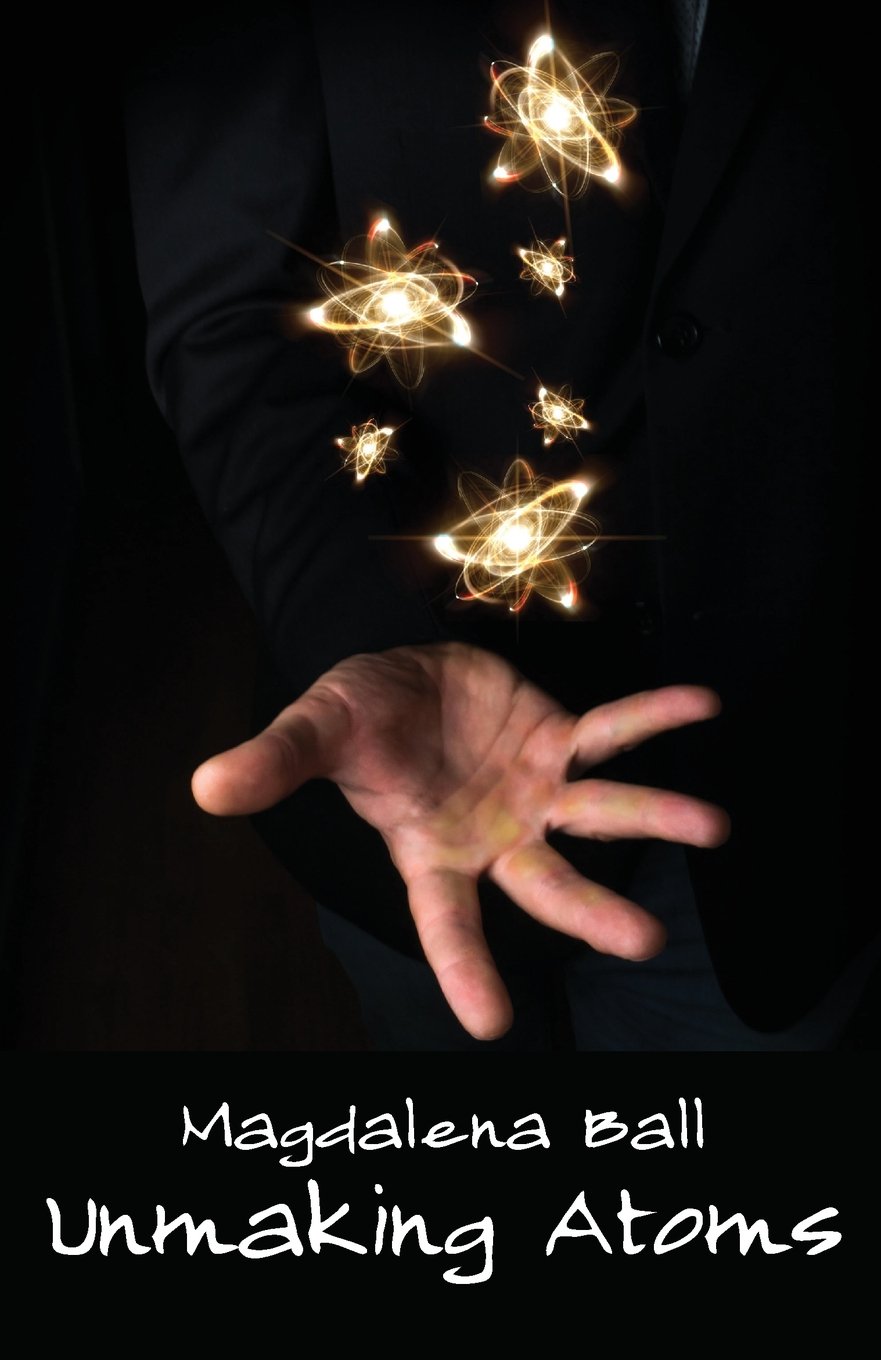
Hi Everyone, I’m excited to report that my new poetry book Unmaking Atoms is now out and available at good bookstores everywhere including Amazon.

I’ve recorded one of the poems in the book titled "Mapping Pluto” which you can listen to here: https://soundcloud.com/maggieball/mapping-pluto-by-magdalena-ball

Of the book, the fabulous Kristin J Johnson said: "However, matter cannot be created or destroyed, and this collection unmakes, and then reassembles, the words and images as well as emotions including the sense of joy that permeates Ball’s lyricism. That joy manifests in a “laugh that shakes the floor,” the line and curve that brings wholeness, a light “softer than the cut of love.”

Bob Rich said: "These are pearls in words; beautiful images in beautiful expressions. They force you to think. There is a kaleidoscope of different ways, all pointing to the same theme. You can immerse yourself in each of 96 offerings like this -- except that no two are alike. Each is a cryptic crossword in 17 dimensions, chasing each other out of sight, a carefully designed Rorschach blot.”

The book will be formally launched at this year’s Newcastle Writers Festival at the Press Book House by the magnificent poet Jan Dean.  Stay tuned for more upcoming events, videos, and giveaways.

Sunday, November 13, 2016

Poetry Monday: Squeezing language like honey - on Eileen Myles’ "The Honey Bear"

I’ve got Eileen Myles’ I Must be Living Twice by my bedside, and every night before I go to bed, I read a poem from it. This very slow reading allows me to take a bit more time than I usually would over each poem, really delving into them and sometimes giving me interesting dreams.  Someone asked me the other day if I was a speed reader or found myself reading faster the older (and presumably more experienced at reading) I got.  My answer was that I am a slow reader and am getting ever slower.  Slow is good, I think.  It’s not so much speed, but the amount of attention I give to what I read.  I want to really experience the things I read - not merely scan or skim over the surface.  That will often take time, and one reading is often not enough for me, especially with poetry.  I have to mull and then return.  I was particularly happy about the opportunity to go even deeper into one of the poems in Myles’ latest collection, which, by serendipity was on the list of essay topics for the ModPo course I’m doing.  The poem is called “The Honey Bear” and you can read the full text of it here: https://media.sas.upenn.edu/afilreis/ModPo/Writing-Assignments-PDFs/Myles_The-Honey-Bear.pdf

Following is my 500 or so (bit more...) essay.  If you have opinions about the poem, please feel free to comment.  I’d love to open a dialogue on this one.

Eileen Myles’ “The Honey Bear” presents what appears to be a straightforward narrative.  A twenty nine year old woman is standing in the kitchen on the eve of her thirtieth birthday, smoking her last cigarette before quitting, making a cup of herbal tea, and sweetening it with honey from a plastic bear dispenser.  On the radio, first we hear Ivy Anderson and then Billie Holiday – both torchy jazz singers.  The scene is suffused with a sense of time passing, both in terms of growing older and with the progression of the clock as the evening moves towards the next day.  The use of the continual present tense, and the prosaic and domestic activity depicted calls to mind the New York School of poetry.  It’s clear by the bathtub being in the kitchen that this is an older style New York City apartment, and the darkness of the music, the tea and the surroundings is offset by the brightness of the artificial lights.  
 It’s impossible to read a poem that follows this sort of progression and urban sensibility while referencing Billie Holiday, without thinking of Frank O’Hara’s “The Day Lady Died”.  O’Hara’s seminal New York School poem becomes a touchstone for this one, evoking the slow sensual pleasure of immediate sensation, from the combination of the music, the scented tea, the honey, and the tactile grooves of the bear’s face.  We know that tomorrow is the speaker’s birthday, that the speaker is alone and using the sensual aspects of the scene to offset the melancholy.  These elements, and even in the little pun in the repetition of the letter O all provide a homage to O’Hara.
 The poem, however, is suffused with rhythm and repetitions that are more stylized, musical and less prosaic than you’d usually find in The New York School. The repeated use of the present participle of verbs like hanging, smoking, singing, squeezing, standing, dripping, starting combines with the assonance of the O sound in Holiday, radio, smoking, odd, suppose, older, and the O in “O it’s very quiet”, “O very sad and sweet”, and “O honey”. Though the poem is only one stanza, about mid-way through it turns at “I’m not a bad looking woman”, interrupting the voices of the jazz singers and changing the form.  Though the scene doesn’t change, there is a progression from the clipped line breaks in the first half of the poem, to the looser structure of the second.  The O sound creates a sense of longing that progresses to sexual desire, intensified by the noodle of honey dripping down the bear’s face.  From this point onward, the poem begins to flow, opening out with mid-sentence spaces that creates a more dramatic, breathless energy: “I suppose     O it’s very quiet” or “in my kitchen tonight      I’m squeezing”.  Other words also repeat: older, sweet, odd, honey, late, kitchen, as the words drop down the page like the honey into the tea.  This dissolution breaks the narrative quality of the first half, becoming more surreal as it zeros in on the nexus of desire, the room’s silence, and the intensity of the moment in which all of these separate senses come together to the final climax of “I’m staring at the honey bear’s face.”  

Monday, June 20, 2016

Poetry Monday: Hazel Smith’s Word Migrants

I’ve just started reading Hazel Smith’s Word Migrants and am already hooked by the richness of the poetry’s presentation: performative modernity coupled with an almost painful intimacy:
Before you disappeared my aloneness was the vibrations of a coastline, I could feel the pitches of the waves beneath my feet. Now the soles of my feet sink into the sand.  And it sticks. (“The Disappeared”)

Smith's The Writing Experiment is one of the best writing manuals available for teaching writers the techniques of experimentation (I use it regularly), and it’s fascinating to see some of those principles in play in Smith’s own poetry as she explores topical issues include the refugee crisis, climate change, political and social abuses, aging, grief, and the nature of privilege and power.

The poems I’ve read so far maintain a lovely delicacy, drawing the reader into worlds which are often dystopian (all too real at times), but also playful, experimental, enlivened by sound and an awareness of the space on the page, exploring the nature of language, semantics, referentiality, and genre, without ever losing their immediacy, contextual relevancy, or coherence.  Here’s another little sample:
Every conversation is a gentle misfiring
   An abacus points beyond method or counting
      An exchange derails, eyes averted, glancing (“Encounter”)
I’ll be reading more deeply over the next week or so and will follow with a full review at Compulsive Reader.  In the meantime, you can found out more about Hazel Smith here: http://www.australysis.com

Monday, January 18, 2016

Poetry Monday: Imperfect Echoes by Carolyn Howard-Johnson

For Poetry Monday this week I’m going to give a shout-out to my writing buddy Carolyn Howard-Johnson, who has a relatively new poetry book out called Imperfect Echoes: Writing Truth and Justice with Capital Letters, lie and oppression with Small. The book includes a few reprints from our Celebration Series collaborations, and is beautifully illustrated with images by Richard Conway Jackson, who is currently in prison in California.  All proceeds from the book are being donated to Amnesty International.  The book was inspired by Czeslaw Milosz' The Captive Mind and includes a range of poems focused around the utterly relevant topics of Peace, Tolerance, Hope, Truth, Justice, and Acceptance (note the capital letters).  Carolyn’s poems, as always, manage the delicate balance between easy accessibility, and deep complexity as they explore big concepts through everyday events.  Here’s a sample from the last poem in the book "Interpreting Fairy Tales"

From That to This,
the connection.
How what I didn’t know
and how the knowing 
changes things. Riotous 
orchids, baa baa black sheep,
ugly ducklings. Here, a single
troll waits under a bridge.

His name is Time.

Monday, November 2, 2015

Poetry Monday: O’Hara’s Why I Am Not a Painter


Last week I wrote my third ModPo essay on Frank O’Hara’s phenomenal “Why I Am Not a Painter”.

You can read the full text of the poem here: http://www.poemhunter.com/poem/why-i-am-not-a-painter/

Following is my essay.  Please feel free to add your thoughts in the comments.

*********

Frank O’Hara’s “Why I Am Not a Painter” uses the “I-do-this-I-do-that mode” to create a narrative context where meaning is created through conjunction, and contrast.  Both of these notions play out with ironic power as O’Hara tricks the reader into the verbal through the visual. For correspondence we have the artistic process of two artists placed on an equal plane: one who creates through a visual medium and begins with the verbal or the word and the one who creates through a verbal medium and begins with the visual or the colour.   In both instances, the painting and the poem’s subjects are condensed into the work, from the visible origins to a highly distilled invisibility that is no less present or powerful for its absence.   The very proximity of these two different artists, friends, who move from “I drink” to “we drink”, becomes a catalyst for the work they create, in the explanations that charge the work through its negation.  The subject is “too much” in both instances, and it is through the artistic process that the subject is distilled beyond recognition.

Beyond the correspondence between the two artists, there is the contrast, which is presented almost as a competition.  Mike Goldberg’s work appears to develop through time in present tense linguistic repetition and conjugation of the verb “go”.  When the work, apparently in progress, is finally so abstract that SARDINES disappears, the only trace we have of the original idea is the label, which remains necessary to impose an organising principle: “it needed something there”.   O’Hara’s work, on the other hand, ends up with a label that is both visual and verbal, a clever bit of trickery that shows us the power of language. Goldberg’s SARDINES is already subverted into this poem, which encompasses the very thing it abstracts: “All that's left is just letters.”  All of this self-conscious irony goes hand in hand with the seeming natural prosaic quality of the work.  While it may, at first glance, appear to be a simple recount in present tense about the meeting of two artists and their mediums, it is, and O’Hara reminds us of this very clearly, actually a “real” poem. The narrative construct, like the progression of time (“the days go by”) is artifice.  This artifice is further emphasized by the line breaks and artificial sentence structures that create a stuttering quality that undermines the natural rhythm of the sentences: “he/says”; “days/go by”; “just/letters”; “be/so much more”.  Each of these word groups breaks at the least natural spot, further heightening the irony and undermining the conversational tone it sets out to parody.  At this point, the artistic process becomes obvious, the work becomes self-consciously meta-poetic, with a victorious twist at the end as the poem circles back to its origins and engulfs the painting.  This poem is autotelic: it transcends its referent - it needs nothing there.  “Why I am Not a Painter” manages to be simultaneous funny and serious, lighthearted but somber (orange is truly terrible, reminding us, in this poem, of death), superficial and deep.  This is a poem that succeeds brilliantly at illuminating everything it claims to elude, making itself the subject.

*************

And just because this is a blog and not an academic site, I’m also appending a wonderful rendition of another Frank O’Hara poem, “Lana Turner Has Collapsed" from Lunch Poems. This song was my first exposure to Frank O’Hara, played for me by the composer, my dear uncle, who I’m fairly sure you can hear laughing at the end of the clip.  I had this song in my head the entire time I wrote that essay and it’s still there now.


Oranges - photo credit: Early morning sunshine via photopin (license)

Sunday, October 18, 2015

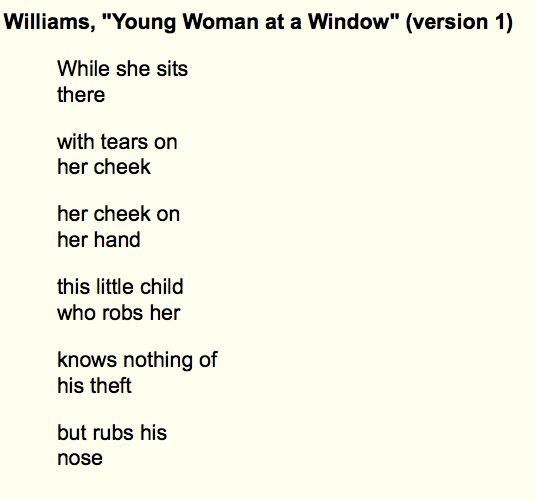
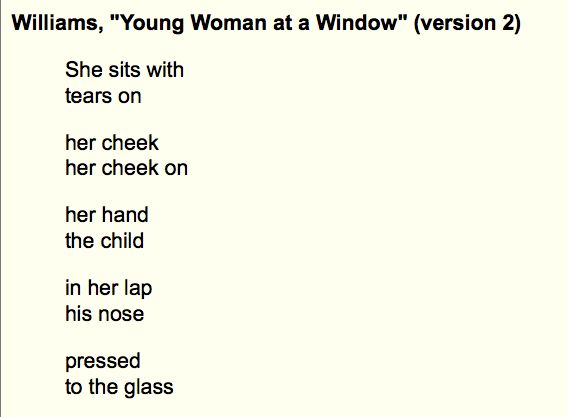
Poetry Monday: Condensation and stillness: two versions of WCW’s Young Woman at a Window

Continuing on from the last Poetry Monday post, I thought I’d post up my second ModPo essay.  Again, this is is the second time I’ve written on this poem, but I haven’t pulled out my old essay (not sure I’ve kept it), and as it has been some years, I have come at this task with beginner’s mind.  I found this essay to be a relatively easy and enjoyable one to write (much easier, for example, than the poetry book review I’m working on - a wonderful but slow and complex read).  The process of writing this has helped me clarify not only the principals of Imagism which we’ve studied, but also allowed me to trace the transition of a poem from good to excellent.  Feel free to add in your own essays, responses and comments.  

There has been much written about William Carlos Williams’ “Young Woman at a Window”, and while we know that second version is the one that Williams ultimately published, it is fascinating to trace the condensation from the first poem to the second, and to explore why the second poem not only adheres better to the imagist manifesto, but is also objectively speaking, a more powerful poem. While both of the poems feature the same objects: a woman and a child at a window, and both have similar structures and the same number of stanzas, the second version has been reduced to 23 words from 29, with a more even cadence and couplets, beginning and ending with 3 words.  The first version is more narrative, leading the reader towards a sentimental conclusion.  The second version of the poem allows the reader to make his or her own inferences, leaving the image clear of inference. In version 1, specific words and sentence structures are used to evoke sentiment. The reader is told that the child has “robbed” the woman, and is unaware that he’s done this.  Also the child rubs his nose – an unappealing act linking the woman’s tears to the boy, and something about the demands of parenting.  That the boy needs his nose wiped becomes the denouement for the poem. In addition, the delicate early rhythm of the poem and its first word repetition is marred by words like “this”, “who,” and “knows” which break the cadence with sentence structure type inclusions that further progress a narrative. 

In the second version of the poem, Williams has condensed the image and removed extraneous words or “vague generalities” like ‘robbed’ and ‘knows nothing’, and actions like ‘wiped his nose’.  Instead the image is static—frozen in time like a statue, and is rather more beautiful as a result.  There are no runny noses here or self-pity.  The reader is confronted with, in the words of the imagists, an “exact visual image” which makes its statement completely. The reader is left free to make inferences about the nature of the tears, about the symbolism of the window which hints at inside versus outside without stating it overtly, and about the reason for the two sitting together in such a pose.

Though there is no expression of ‘robbery’, the image is suffused with sadness and longing, but only by virtue of the imagery. Ending the poem on the word “glass” creates a perception of being cloistered, without the need to state it.  Finally, and perhaps most importantly, the second poem not only uses the image itself to convey meaning, but it is structurally and rhythmically aligned, using repetition and alliteration of the words “her” at the start and “on” at the end of the first three stanzas, and the sibilance in “nose”, “pressed”, “glass” which convey both silence and tears.  This poem works perfectly when read out loud, encouraging the reader to just look, to just feel and just participate directly in the subtle longing and sense of cessation conveyed by the poem.

Monday, February 16, 2015

Poetry Monday: Joanne Burns

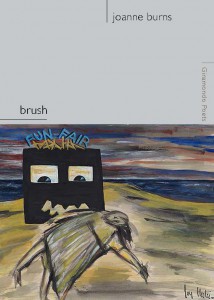
It’s been a long sleep between Poetry Mondays - sorry readers!  It’s not because I haven’t been reading poetry - far from it.  In fact, tomorrow I’ll be interviewing Philip Salom about his phenomenal and challenging poetry triptych Alterworld, which accompanied me through the Whitsundays.   I’ve just done a bit of a clean-up of my bedside table and behold, there was Joanne Burns’ Brush with its colourful and surreal Ned Kelly-like cover art painted by Joy Hester.  Brush had been there all along, hidden beneath a pile of chunkier bully books.  I picked it up and began reading, and was immediately taken in by the up-to-the-minute sharpness of Burns’ words, the playfulness, the taut and very modern intensity, and how relevant the poems are.  Here’s a bit from the opener, “factoidal”:
does your share portfolio ache
unlock your teeth in the adrenal winds,
the facilitationality of a sea of nomadic desks
doesn’t need to be seen to be believed --
Not once does Burns let the reader off the hook.  There’s plenty of tenderness and playfulness, but always with a reminder of our posturing, our facades, our absurdities, and by ‘our’ I really mean ‘my’.  Despite the sharp edges, it seems like each poem finishes with a little wink - a kind of “get it” that allows the reader to join in the laughter (“It’s neptune or never”).  I’m still reading and intend to take my time, as I like to with poetry - reading a couple of poems before bedtime and letting them unhinge my dreams, then sneaking one during the day, maybe a few more in the afternoon...almost clandestinely, working through them secretly in my head.  If you’d like to sample a bit more of Burns, there are 249 (!) of her poems here at the Australian Poetry Library.  I quite liked “Thief” which you can read in its entirety at:  http://www.poetrylibrary.edu.au/poets/burns-joanne/thief-017700
he would chew
deep through the moon
offering us just the dust
and thread every little star
through the spaces in his thought

Sunday, January 4, 2015

Poetry Monday: Poetry for the New Year: Lorine Niedecker (again)

Not long ago I did an interview with the poet Jennifer Compton at the Newcastle Poetry Prize ceremony.  During our pre-interview conversation (and during the interview too), we discussed how poetry “removes the poison” from life’s most painful moments.  This continues to be true for me, both as a writer of poetry and as reader.  I lost my mother rather suddenly around this time last year, and though it never stops hurting - I don’t expect the pain to ever dull - the shared understandings that poetry creates - a sense of beauty from the senseless ugliness of death - does indeed remove the poison.  This beautiful little new years poem from Lorine Niedecker demonstrates this perfectly:  https://twitter.com/LorineNiedecker/status/509355006118858752

I highly recommend that you click the link and read it. It won’t take you long.  The poem’s brevity is breathtaking. Niedecker writes in her distinctively succinct way (each word packed tight and resonating with multiple meanings) of loss, love, and new starts - the way the loss of a parent is brought home with milestones like new years day, and the way a parental voice continues to ’speak’ through the seeds they’ve planted; through the turning of years and this permanent and ongoing dialogue between parent and child.  I particularly love the last two words, separated in a way my computing skills probably can’t convey (hence the link) and left open for the reader to interpret: the word “spoke” functioning as both noun and verb, uniting past, present and future.

I’ve been participating in a discussion forum on Lorine Niedecker and Emily Dickinson run by the Kelly Writers House, and the poem was presented today by Al Filreis, who is wonderfully curating and driving (or encouraging - Filreis is always Socratic in his approach) these close readings. Coming across a poem like this, in the midst of my ongoing, private grief, is like slowly walking beside the trees on new years day with Niedecker, sharing this beauty and this pain.  There is no poison here.

Monday, November 10, 2014

Poetry Monday: Poems of New York

I'm becoming partial to small hardbacks these days.  I'm not sure exactly why, but I know that at least part of it is the simple utility of them - they fit neatly in my handbag, don't overly clutter up the bedside table, and are light and easy to take around.  They're also lovely - all solid and jacketed, with thick creamy pages and a lovely feel in the hand.  Kathryn Fry, herself a fine poet, loaned me this copy of Poems of New York, edited by Elizabeth Schmidt.  Putting aside my great stacks of review copies waiting for attention, I decided to delve in immediately.  I like to read poetry slowly, over a period of time, reading one poem and carrying it around with me, thinking about it and living it for a bit - seeing how it colours my perception, and Poems of New York has been perfect for that.  It has also made me nostalgic, taking me down streets I used to walk, through conversations I probably had, to meals and parties and sensations that are uniquely linked to the city I grew up in, but am now a long way from.  Though small, the book is dense and contains work from writers as diverse as Whitman, Melville, Amy Lowell, Wallace Stevens, William Carlos Williams, Marianne Moore, Edna St Vincent Millay, Dorothy Parker, EE Cummings, Langston Hughes, Auden, Bishop, O'Hara, Ginsberg, Ashbery, and the list goes on, including some modern poets too like David Berman, Melanie Rahak, and Nathaniel Bellows.  There are old favourites in here - poems I've memorised even, and new ones that touch on very modern subject matters.  I could write a little essay on each poem, I think,
or write a lengthy review which teased out styles, moods, linguistic tricks, moments of beauty, and so on, but I think I'll just single out one poem by Nikki Giovanni titled "Just a New York Poem".  I've chosen this one partly because it captured my mood at the time I read it (and I've only just read it), partly because it's in the public domain and appears safe to reprint, and partly, and above all, because it is somehow indicative of New York as it sits in my memory - simultaneously dynamic and full of life, and a place that exists only in time rather than in space.

i wanted to take
your hand and run with you
together toward
ourselves down the street to your street
i wanted to laugh aloud
and skip the notes past
the marquee advertising “women
in love” past the record
shop with “The Spirit
In The Dark” past the smoke shop
past the park and no
parking today signs
past the people watching me in
my blue velvet and i don’t remember
what you wore but only that i didn’t want
anything to be wearing you
i wanted to give
myself to the cyclone that is
your arms
and let you in the eye of my hurricane and know
the calm before

and some fall evening
after the cocktails
and the very expensive and very bad
steak served with day-old baked potatoes
after the second cup of coffee taken
while listening to the rejected
violin player
maybe some fall evening
when the taxis have passed you by
and that light sort of rain
that occasionally falls
in new york begins
you’ll take a thought
and laugh aloud
the notes carrying all the way over
to me and we’ll run again
together
toward each other
yes?