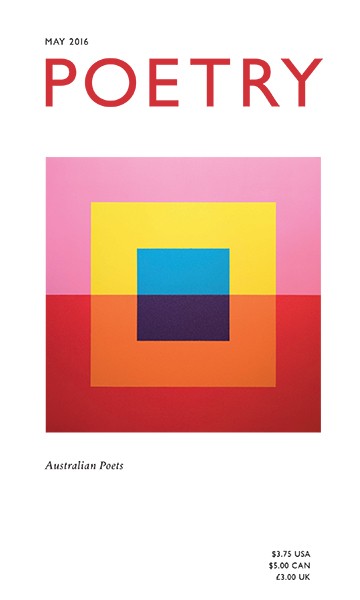
This is a bit late, as I decided to write about the May issue of Poetry Magazine some weeks ago and got waylaid by a few other literary activities. This month’s issue was guest edited by Robert Adamson, one of Australia’s best known contemporary poets, and features beautiful portraits from Juno Gemes. If you aren’t already familiar with the fresh, often beautiful, sometimes shockingly uncomfortable poetry being produced from Australian writers at the moment, this issue is an excellent place to start, as it features the work of some of the most innovative and powerful poets writing today including Bonny Cassidy, Ali Cobby Eckermann, Jaya Savige, Gig Ryan, Robbie Coburn, Luke Davies, Lisa Gorton, Anthony Lawrence, and many others. If you are already familiar, then you’ll know this issue is a massive treat, full of rich and powerful work. But don’t take my word for it. Drop over the website and listen to the podcast, which includes poets like Lionel Fogerty, Jaya Savige and Ali Cobby Eckermann reading from their own work in a way that adds a great deal of depth to the poems. There’s not a single poem in this collection which isn’t exquisite and moving. Some, like Luke Davies’ "Heisenberg Saying Goodbye to Mum at Lilyfield”, or Lisa Gorton’s “Empirical IV” left me struggling to swallow from the lump in my throat. But to pick and choose a few poems to highlight would not be appropriate. Every single one of these poems deserves to be read slowly, savoured and pondered. Adamson has done a superb job with his selections. Podcast is here: http://www.poetryfoundation.org/poetrymagazine
You can also check out each poem via the table of contents or subscribe here: http://www.poetryfoundation.org/poetrymagazine/toc/detail/88998
Showing posts with label poems. Show all posts
Sunday, May 29, 2016
Poetry Monday: Poetry Magazine’s Australian issue
Labels:
#poetrymonday,
Australian poetry,
poems
Monday, October 26, 2015
Poetry Monday: Ouyang Yu’s Fainting with Freedom
One of the things I like to do when I get a new book is to get the measure of the thing. I like to look the whole book over, skim through the pages, get a feel for its girth, its style, its feel. This is particularly the case with poetry. I like to orient myself to the book and have a few tasters before I go in again more slowly, taking each poem in turn. That’s what Poetry Monday is all about: the initial reading before the reading. I also like to think of it as my little own version of “gathering paradise”, to steal a phrase from my favourite poetry site PoemTalk, where it was nicked, of course, from Emily Dickinson’s “I dwell in Possibility”. It’s a little bit of poetry paradise into which I’m about to immerse myself.
As the author of some 75 (!) books of poetry, fiction, nonfiction, translation and criticism (the number continues to grow), Ouyang Yu’s literary influence is undisputed.
I interviewed Ouyang Yu back in 2007, after he published his book On the Smell of an Oily Rag. During that time, he told me that the wasn’t in the habit of putting himself into pigeon holes: "I might as well call myself a poetnovelisttranslatoressayistcritic". I think that label, if one were required (of course it isn’t), could be applied to his new book Fainting with Freedom. Many of the poems read like little stories or narratives, full of (often subversive) fun, dismay, intensity, longing, and Ouyang Yu’s characteristic word play that always breaks linguistic boundaries.
Here’s a very brief sample:
Hills flow in wavelets, brown-green, yellow-red, pink-dark. Empty sticks of trees, through which glimpses of clouds topping the hills. One lone tree, another, another, a shadow stretching across the tableland, darkening the feeding sheep. Dots of grey. Sudden water sky. (“Biography”)Full review, as always, to follow.
Labels:
#poetrymonday,
Australian poetry,
OuyangYu,
poems
Monday, June 29, 2015
Poetry Monday: Ali Cobby Eckermann’s Inside My Mother
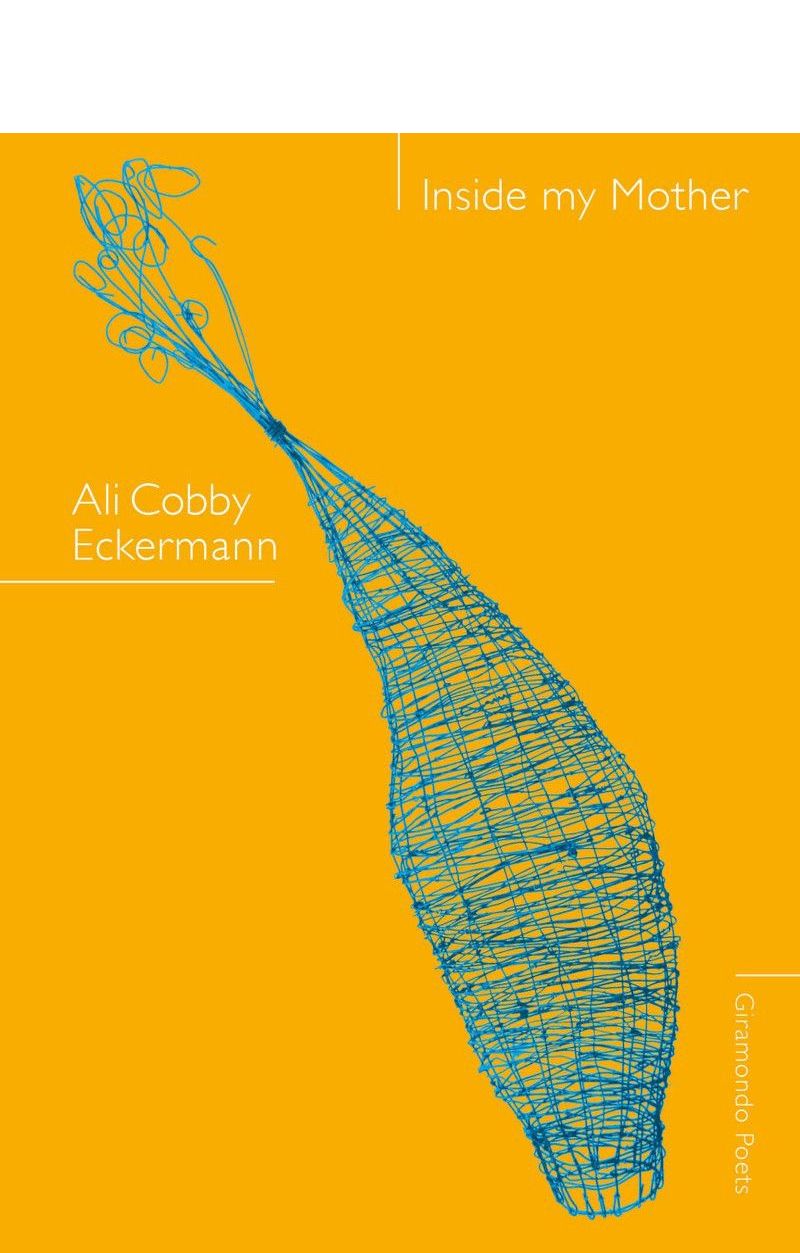
I know it’s not Monday where I am, but my blog, being on US time, still says it’s monday, so I’m going to take the opportunity to showcase a poetry book that is being published tomorrow. Some weeks ago I blogged about a poetry session My Mother’s Heart that I attended at the Sydney Writers Festival. Ali Cobby Eckermann’s new poetry book, from which she read, has now arrived, and at first glance, I’m very excited by it. The work is rooted in the earth, and rich with legend, many stories, love, fear, loss, lost vernacular, a beautiful, and at times terrible history, healing, and as the title suggests, the nature of the maternal, in all its metaphoric implications. I’ve only skimmed the surface so far, but I’m looking forward to reading through it slowly and deeply and finding new meaning, and new ways of looking at the world through this work: “there’s a whole ocean filled with sand
between what was and what will be”
More about Ali Cobby Eckermann and her work can be found in this recent interview at Mascara Review: http://mascarareview.com/ali-cobby-eckermann-in-conversation-with-jaydeep-sarangi/
The book is available, from tomorrow, directly from Giramondo.
Labels:
#poetrymonday,
Aboriginal poetry,
Australian poetry,
poems
Sunday, May 24, 2015
Poetry Monday: A Mother’s Heart
This Saturday, at the Sydney Writers Festival, I had the pleasure of listening to some ten poets (11 if you count the English “heckler” who was invited to join in) reading to the theme of Give Me Back my Mother’s Heart at Wharf Theatre 2. The performers were from across the Aboriginal nations, with the exception of the ring-in, whose British/Caribbean work was in sync with the theme but infused with the pain of diaspora, rather than displacement. It was so polished and powerful, I knew he wasn’t really a ring-in.

Ali Cobby Eckermann, Director of Aboriginal Writers Retreat, led up the group, whose work was confronting, intense, angry, funny, powerful, and often delivered with the memorable punch of Slam. Ali’s own opening poem, “I Tell Ya True”, which you can read in it’s entirety on Poetry International Web, presented a moving reminder not to judge others:
What I liked best about the session was how tightly linked the poets were and how the poetry managed to bridge the gap between a deep timelessness and a very modern streetwise sensibility. Though the work was inherently different: the voices, the ages, the level of experience, and even the backgrounds varied, there was such a powerful camaraderie and connection between the writers and their sense of being part of a single voice gaining collective strength through mutual support. The audience felt it too: participating with whoops, applause, shout-outs, gasps, tears, and laughter. It was a great session that left me feeling very excited by what I heard. I’ll be hunting down Eckermann’s forthcoming book Inside My Mother (it’s Giramondo, who else), and books by other members of the group, as I was left wanting more. I just wish I could find the name of that British fake-heckler “ring-in”, as he was really good.

Ali Cobby Eckermann, Director of Aboriginal Writers Retreat, led up the group, whose work was confronting, intense, angry, funny, powerful, and often delivered with the memorable punch of Slam. Ali’s own opening poem, “I Tell Ya True”, which you can read in it’s entirety on Poetry International Web, presented a moving reminder not to judge others:
you never knowEckermann’s co-collaborator at Aboriginal Writers Retreat was Lionel Fogarty, who, along with Maggie Walsh, Ken Canning, Lorna Munro, Elizabeth Wymarra, and a group of poets from the Redfern Writers Group, presented a varied selection of work, full of stories of loss, love, pain, about losing mothers -- sometimes through having been stolen away during the disastrous Child Removal Policy in 1969, and about finding mother’s heart beating in ones own chest: “all here without our mothers...”. I found myself laughing, crying, feeling ashamed and feeling proud throughout this session in various parts, and sometimes all of those things at once.
what sorrows we are nursing
What I liked best about the session was how tightly linked the poets were and how the poetry managed to bridge the gap between a deep timelessness and a very modern streetwise sensibility. Though the work was inherently different: the voices, the ages, the level of experience, and even the backgrounds varied, there was such a powerful camaraderie and connection between the writers and their sense of being part of a single voice gaining collective strength through mutual support. The audience felt it too: participating with whoops, applause, shout-outs, gasps, tears, and laughter. It was a great session that left me feeling very excited by what I heard. I’ll be hunting down Eckermann’s forthcoming book Inside My Mother (it’s Giramondo, who else), and books by other members of the group, as I was left wanting more. I just wish I could find the name of that British fake-heckler “ring-in”, as he was really good.
Monday, August 4, 2014
Poetry Monday: Adrienne Rich
![]() |
| Photo credit: Dorothy Alexander |
little excerpt:
"If this were a map,
she thinks, a map laid down to memorize
because she might be walking it, it shows
ridge upon ridge fading into hazed desert
here and there a sign of aquifers
and one possible watering-hole." The other one is "Planetarium". You can read the whole thing here:
http://www.poetryfoundation.org/features/audioitem/4046
just a wee excerpt here;
"What we see, we see
and seeing is changing
the light that shrivels a mountain
and leaves a man alive
Heartbeat of the pulsar
heart sweating through my body
The radio impulse
pouring in from Taurus"
You know you want to read more. Go find Adrienne. She's waiting for you, "for the relief of the body/and the reconstruction of the mind."
Labels:
#poetrymonday,
poems,
poetry
Monday, July 7, 2014
Poetry Monday: Czesław Miłosz
It must have been some 30 years ago when I went to hear Czesław Miłosz read his work in New Jersey at Princeton. What I remember most was the intensity of his gaze, the way he lost himself in his words as he read, and power that resided as an undercurrent to the simplicity of his words (especially in light of the literary pyrotechnics I was usually drawn to at the time). It was a relaxing evening, involving, if I recall correctly (memory being entirely unreliable), wine, cheese and very little intimidation or pomposity, in spite of the grandeur of our surroundings and the size of the audience, given Miłosz' fame at the time. I've just re-encountered him and the poem below, through a course at the University of Iowa titled How Writers Write Poetry which I couldn't resist checking out (did I mention how easily distracted I am at the moment?) - you can still jump in - this one is totally ungraded. The workshops have already spurned several new poems, as has my other MOOC course through Coursera How to Change the World, which I'll be posting on shortly if I can find a moment to summarise my thoughts between all the readings. For now though, here's are a few of my favourite Miłosz poems courtesy of the Poetry Foundation to start the week.
Encounter: http://www.poetryfoundation.org/poem/179568
Ars Poetica: http://www.poetryfoundation.org/poem/179563
Account: http://www.poetryfoundation.org/poem/179608
Encounter: http://www.poetryfoundation.org/poem/179568
Ars Poetica: http://www.poetryfoundation.org/poem/179563
Account: http://www.poetryfoundation.org/poem/179608
Labels:
#heypoets,
#poetrymonday,
poems,
poetry
Monday, May 12, 2014
Poetry Monday: Michael Brennan
There is no one to save us from these microbes, the shuffling deck. So many points on/our horizon we could launch out from the/random mutation we share. Onwards then, until we find each other ready-made and to order.I've only just begin plunging into this book, which is as fun as it is intense. The sensibility is very modern, moving between the joy and terror of the circus, to social networks, texting, global warming, Tag Hauer watches to the Dalai Lama. I've still got a a long way to go with the book, but I'm finding the reading quite exhilarating at this stage. If you want more, here's a complete piece from the book titled "Who is Alibi Wednesday": http://redroomcompany.org/poem/michael-brennan/who-alibi-wednesday/ that takes a rather shocking (and moving) look at the migrant experience: "When you feel the blade's tongue lick your throat,/you are still giddily scratching surfaces, falling in love with the city."
Cognitive dissonance here we come. Autoethnographic is Brennan's third full length collection. He is a lecturer in the Faculty of Policy Studies, Chuo University, Tokyo, and is the director of Vagabond Press, and the Australian editor of Poetry International Web.
Labels:
#poetrymonday,
Australian poetry,
poems
Monday, May 5, 2014
Poetry Monday: Poetry for Mother's Day (freebie)
This Mother's Day will be bittersweet for me. Sweet, because I have three wonderful children and a terrific husband who will be celebrating the day with me. Bitter, because it's the first Mother's Day ever where I am unable to phone my mother, send her a gift, or thank her for being wonderful. I will, of course, spend the day, as I have done every day since she passed away on the 30th of January this year, thinking about her, missing her, and perhaps writing about her.
At my mother's memorial, I grabbed a copy of the poetry book Carolyn Howard-Johnson and I co-authored from her bookshelf, and read a poem from it about how I used to climb into her bed as a young child, and how safe it felt to me (my own children did the same when they were younger...). I've reprinted that poem below. Of course, I'm not the only one in the world who has lost my mother. She Wore Emerald Then
was released the week of the death of Carolyn’s mother, so the
book, which has always been tied to Mother's Day, has a certain
poignancy for both of us.
Carolyn and I are going to be running another freebie this year at Amazon. If you don't already have a copy of She Wore Emerald Then, which features beautiful photography from May Lattanzio, please go and grab a copy for free here: http://www.amazon.com/She-Wore-Emerald-Then-Reflections-ebook/dp/B00BXPW2XO anytime from the 5th to the 9th of May (US dates).
If you're a mother, or if you have a mother (and that's all of us, even those of us whose mother is no longer alive), please have a happy Mother's Day, even if that happiness is tinged with longing, because every beautiful moment has a kind of permanence to it, even as it disappears into the transience of time.
At my mother's memorial, I grabbed a copy of the poetry book Carolyn Howard-Johnson and I co-authored from her bookshelf, and read a poem from it about how I used to climb into her bed as a young child, and how safe it felt to me (my own children did the same when they were younger...). I've reprinted that poem below. Of course, I'm not the only one in the world who has lost my mother. She Wore Emerald Then
was released the week of the death of Carolyn’s mother, so the
book, which has always been tied to Mother's Day, has a certain
poignancy for both of us.
Carolyn and I are going to be running another freebie this year at Amazon. If you don't already have a copy of She Wore Emerald Then, which features beautiful photography from May Lattanzio, please go and grab a copy for free here: http://www.amazon.com/She-Wore-Emerald-Then-Reflections-ebook/dp/B00BXPW2XO anytime from the 5th to the 9th of May (US dates).If you're a mother, or if you have a mother (and that's all of us, even those of us whose mother is no longer alive), please have a happy Mother's Day, even if that happiness is tinged with longing, because every beautiful moment has a kind of permanence to it, even as it disappears into the transience of time.
Mother's Bed
In the restless
night
when mortality
lurks in every shadow
the blanket won’t
cover your fear
and morning is a
half-forgotten dream
vague and
uncertain,
slink into my bed
the pillow holds a
mother’s secret
whispered charm
you can sink your
head into.
There are no
demons here;
no whirlwind of
memory and anticipation clouding sleep
only eternal
warmth
a shared space
free from the
ticking illusion
of time, motion,
and change.
Here, where you
are always welcome
nothing matters
except this peace
this place
containing every
possible now.
Labels:
Mother's Day,
poems,
poetry
Sunday, March 2, 2014
Poetry Monday: Pitt Street Poetry
Those of you who have been following this blog for a while will know that last year, in the lead up to the Newcastle Poetry Festival, I ran little profiles of the people who were joining me on my poetry panel - tasters if you will. This year the topic will be "How Do Poets Survive", and I'll be chatting with David Musgrave, who was also on my poetry panel last year, Christopher Pollnitz, Rob Riel, and John Knight of Pitt Street Poetry. This is a free event held onMulubinba Room - Newcastle City Hall, and knowing the work of the amazing poets and poetry publishers who are joining me to discuss the topic of publishing poetry and the dynamic between poet, editor and publisher, I am confident in saying that this will be a session well worth attending, full of lively, topical chatter and lots of opportunity (as with last year) for audience interaction. Today I'm going to kick off the series with a little profile on John Knight's wonderful Pitt Street Poetry press.
Anyone who writes poetry and wants it published will be well aware that there aren't very many traditional publishers out there, and most of them are doing it more for love than for the (somewhat less than copious...) financial rewards. The love is often considerable and the resulting collections exquisite, as is clearly the case with PSP, who started up in 2012 with two collections: Travelling with the Wrong Phrasebook by the amazing Jean Kent (who was on our panel last year - you can search her up in the archives for more on Jean and her work), and Light Pressure by John Foulcher. Since then, PSP has grown rapidly and now aims to publish 4-6 new collections a year, as well as pocket-sized editions of out-of-print classics from the last fifty years. They've got some pretty big names on their books already including the likes of Luke Davies, Ron Pretty, and Mark Tredinnick- just a few of those you might have heard of, though there are plenty more upcoming poetry collections from names familiar and new, with an eclectic mix of e-books, inexpensive pamphlets, paperbacks, and beautiful casebound illustrated and autographed editions that make lovely gifts. As both writer and reader of poetry, I'm so glad that publishers like PSP are continuing to put out the good stuff.
![]() |
| Dr John Knight |
Anyone who writes poetry and wants it published will be well aware that there aren't very many traditional publishers out there, and most of them are doing it more for love than for the (somewhat less than copious...) financial rewards. The love is often considerable and the resulting collections exquisite, as is clearly the case with PSP, who started up in 2012 with two collections: Travelling with the Wrong Phrasebook by the amazing Jean Kent (who was on our panel last year - you can search her up in the archives for more on Jean and her work), and Light Pressure by John Foulcher. Since then, PSP has grown rapidly and now aims to publish 4-6 new collections a year, as well as pocket-sized editions of out-of-print classics from the last fifty years. They've got some pretty big names on their books already including the likes of Luke Davies, Ron Pretty, and Mark Tredinnick- just a few of those you might have heard of, though there are plenty more upcoming poetry collections from names familiar and new, with an eclectic mix of e-books, inexpensive pamphlets, paperbacks, and beautiful casebound illustrated and autographed editions that make lovely gifts. As both writer and reader of poetry, I'm so glad that publishers like PSP are continuing to put out the good stuff.
Labels:
#newwritersfest,
#poetrymonday,
Australian poetry,
poems
Monday, November 25, 2013
Poetry Monday: Kate Middleton following the Colorado River
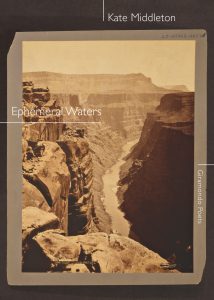
Though you may have dropped by expecting the Dutchess of Cambridge, the Kate Middleton I want to profie today is the author of the exquisite book Ephemeral Waters which was launched last week by Chris Andrews. Ephemeral Waters is one long poem, broken up into 9 parts including an Instruction (Prologue) and a Relection, After.
The work winds its way with the 1,450 mile river, moving from Colorado through Utah, Arizona, Nevada, California, and Mexico like a poetic tour guide, picking up pieces of information, detritus, visiting side roads, recreation areas and museums, and holding conversations with strangers. It's a fantastic journey that reveals more than simply one place or one space, but also carries us into the heart of humanity, of our frailties, and of the fragility of the natural world on which we rely. Here's a tiny snippet from the "Instruction (Prologue)":
Drive You will learn
something You will learn
nothing but absence, but rock's
wonderful indifference
Middleton's poetry has won a number of prestigious awards (including the WA Premier's Award for Poetry). She was the inaugural Sydney City Poet until 2012. You can grab a copy of the book here: http://www.giramondopublishing.com/poetry/ephemeral-waters/
The work winds its way with the 1,450 mile river, moving from Colorado through Utah, Arizona, Nevada, California, and Mexico like a poetic tour guide, picking up pieces of information, detritus, visiting side roads, recreation areas and museums, and holding conversations with strangers. It's a fantastic journey that reveals more than simply one place or one space, but also carries us into the heart of humanity, of our frailties, and of the fragility of the natural world on which we rely. Here's a tiny snippet from the "Instruction (Prologue)":Drive You will learn
something You will learn
nothing but absence, but rock's
wonderful indifference
Middleton's poetry has won a number of prestigious awards (including the WA Premier's Award for Poetry). She was the inaugural Sydney City Poet until 2012. You can grab a copy of the book here: http://www.giramondopublishing.com/poetry/ephemeral-waters/
Labels:
Australian poetry,
poems,
poet,
poetry
Monday, October 7, 2013
Poetry Monday: Rochelle Owens
Rochelle Owen is a poet, playwright, translator and video artist who has published, among many other things, eighteen books of poetry, the latest of which is Out of Ur just released by Shearsman Books.
Out of Ur is an extraordinary collection of new work and older work taken from the period between 1961 and 2012. The poems meld classicism with a post-modern sharpness. The work is simultaneously lyrical and starkly confronting. The poems, which I'm still in the process of reading, take the reader in multiple directions, sometimes at the same time - moving outward to places like the streets of Marrakech, and inward into the brain or the makings of the creative process. Observation and realism mingle with meta-poeticism. It's dense and satisfying work that I'm looking forward to spending more time with.
The PennSound page on Rochelle Owens is a treasure trove of MP3s, videos and text collected from a variety of readings, which will no doubt be augmented by the upcoming reading by Rochelle and her equally illustrious husband George Economou at the Kelly Writers House in Pennsylvania on Thurs the 17th of Oct at 6pm (Arts Cafe if you're in the area). The following little excerpt is from the poem "The Glacier" which is published in its entirety in Out of Ur:

‘Green the gardens of Tuscany’
the word ‘avore’ tattood on her forehead snow forming ice
the glacier expanding outward outward moving slowly slowly
lumps of ice tilting twisting rows of words order of words
‘Green the gardens of Tuscany’
parts of words
the word ‘abandon’ stuck in her throat lovely the letters like roots
spirals of roots multicellular
slender pliant twigs
lovely the letters like arteries
Labels:
#poetrymonday,
American poetry,
poems
Sunday, June 9, 2013
Poetry Monday: Lisa Gorton
Flipping through my overloaded bookshelves to decide what to read next is never an easy task. I'm not complaining one bit, but there are so many good books that come through my letterbox (a reviewer perk), that I sometimes have to make a cursory judgement using a combination of name (have I read and liked their work before?), cover, publisher reputation, and how hard the publicist has worked to get my attention (the good ones contact me personally and tell me exactly why I'll love a book - we all hope for a publicist like that one day...). Well-respected poetry publisher Giramondo never tries to get my attention, but they do send me great, innovative poetry books on a regular basis and even if I've been swayed and distracted by a great publicist, I'll always try to flip through what they send especially if I've been reading a lot of prose (as indeed I have) and need a poetry break (I do). In this case the book I picked up was Lisa Gorton's Hotel Hyperion. I'll be writing a full, detailed review soon, but as has been my tendency lately, I wanted to give you a quick taste of what I've been absorbed with in that fresh flush of discovery, before I synthesise and summarise it.
Gorton could be talking about her own poetry when she says: "Now the reader is walking out into the garden,
into the long rain breaking itself against the glass,
and what was soft tumult
proves itself new and utterly precise." (15, "A Description of the Storm Glass and Brief Guide to its Use in Forecasting Weather" "VI")
Following is Gorton herself reading (beautifully) three of my favourite (so far) poems from the book - the first three in the section that gives the book its title "The Hotel Hyperion". I think, once you begin to listen, you'll see exactly why I love them. The blend of sci fi, desire, a domestic, female kind of longing, and the crispest imagery make these poems both exquisite and powerful.
Labels:
Australian poets,
poems,
poetrymonday
Sunday, March 31, 2013
Poetry Monday: Anna Kerdijk Nicholson
Just by way of one last reminder (here on this blog anyway) that next Saturday from 2:00pm to 3:00pm, I'll be talking about The State of Australian Poetry (state, states, status, standard - with such an amazing group of people, anything can happen) with David Musgrave, Jean Kent, Philip Salom and Anna Kerdijk Nicholson at the The Lock-Up Cultural Centre (Gallery) on 90 Hunter St as part of the inaugural Newcastle Writers Festival. This is a free event, and you, of course, are invited to join us. I've been profiling my the wonderful poets that are joining me next weekend here on the blog and Anna Kerdijk Nicholson is the last (but definitely not least). Not only does Anna work as a lawyer, but she's also the director of Australian poetry and an amazing poet (which completely undermines my theory that poetry and law are opposites). Her latest full length poetry book Possession, which won the 2010 Wesley Michel Wright Prize and the Victorian Premier's Prize for Poetry, is a poetic exploration of the voyage of James Cook in the Endeavour 1768 -1771, and moves through time and space to give us a very different kind of history - one that cuts, burns and ultimately moves us in ways that no prosaic narrative could.The following poem, "Desert", published in Cordite 41, Transpacific, goes deep into the heart of the Australian desert. The voice is deeply Australian (though Anna is a migrant, like me), delicate and sharp at the same time, reminding us of the transience and beauty of nature coupled with the sharp, angry politics of detention and fear. Following is a snippet, but you can (and must) read the poem in full here: http://cordite.org.au/poetry/transpacific/desert-2/.
allows wildflower murders the momentary, untouched granular, hiddenhas emu-light, river gum, sockets of stone huts, is always being left
Labels:
Australian poetry,
poems,
poetrymonday
Monday, March 4, 2013
Poetry Monday: Jean Kent
As some of you may know, I'll be running a session at the Newcastle Writers Festival, Saturday the 6th of April on "The State of Poetry in Australia" with David Musgrave, Jean Kent, Philip Salom, and Anna Kerdijk Nicholson. I'm not sure I'll have time to read the latest book by each of the poets on the panel, and it's not mandatory for me to do so, but considering the quality of the people on our panel, I'm happy to have an excuse to try. These poets are some of Australia's most dynamic, exciting, and powerful poets (and that's saying something - not that I'm biased or anything), so I'm not only going to be immersed in wonderful words in the lead up to the festival, I'm going to be sharing them here every monday. First on the list is Jean Kent, a poet I've had the pleasure to meet on a number of occasions, since she lives reasonably close to me. Jean's work has won a swag of awards, including the prestigious Josephine Ulrick and Dorothy Porter prizes. Her latest book is Travelling with the Wrong Phrasebook, published by Pitt St Poetry, and launched in 2012 by Judith Beveridge. The book is something of a rich, delicate travelogue, taking the reader through Paris, Lithuania, and back to Australia. The poems combine, in a way that Kent seems to have mastered, an intensely focused domesticity with the wonder of discovery. The scenes in these poems are as familiar, and at times, comforting, as our own kitchens, and as unusual and alien as a foreign language. That Kent manages the balance perfectly is part of her great talent:So much gets lost
Between the words on one page with their scythes
And floating hats, the letters alive like the air in the forest
With gnats and bird swoops and antler hooks
I have a feeling that this is going to be a rather extraordinary conversation.
Labels:
literature,
Newcastle poetry,
poems,
poetics,
poetry
Sunday, February 3, 2013
Poetry Monday: Charles Alexander (Near or Random Acts)
Though ModPo is now long finished for me (a new one is happening in September and I recommend it wholeheartedly), I'm still listening regularly to Poem Talk at Penn Sound, moderated by the wonderful Al Filreis. The latest episode looks at Charles Alexanders' Near or Random Acts, a book that has a strong post 9/11 theme, using tight constraints around the the focal point of Alexander's young daughter Nora. The extended poem has a personal structure - 5 words per line, 7 lines per section (Nora being 7 and Alexander being 35 - 7x5). The writing of the poem was interrupted by 9/11 and when Alexander came back to it, he put in an additional constraint to one of the sections which is covered well in the Poem Talk episode (58) - the acrostic use of the word "tower" to make up each of the letters of each line. Here's section 58 in its entirety:58
the other world even rises
to outwit walls' erased rubble
that otherwise would easily resist
twilight's only willful edged rebuttal
try our waffles early riser
taste our wishes every reason
turn off war's echo restless
The result is a powerful mingling of horror and death with life and domestic care - a mingling that permeates the work and continues to be relevant to a modern reader. You can check out sections 56-66 here:
http://writing.upenn.edu/~afilreis/88v/alexander-charles-near-random-acts-secs56-66.html
I'm looking forward to reading the rest of the book. In the meantime, enjoy the waffles.
Labels:
#poetrymonday,
poems,
poetry
Monday, December 10, 2012
Poetry Monday: Jennifer Maiden's Liquid Nitrogen
The poems in Jennifer Maiden's sixteenth collection, Liquid Nitrogen, are hard edged and political, building from the
domestic to the political in verse that weaves Australian, US, and
British politics into a triumverate that is, at once, humorous, pithy,
terrifying, and cumulative. The work is always immediately topical,
bringing in references so diverse that the poems seem to contain a
universe of modern affairs built, through strange parataxes, into a
narrative of our times. Somehow, amidst all the public
activity, the poems retain their personal, intensely female perspective,
and also remain, almost consistently, self-referential (meta-poetic if
you like). Take for example, this excerpt from "Carina":...I touch her arm.
It is stunningly cool but alive
within with information, like
liquid nitrogen, I say gently,
'This is a story. The binary
nature of poetry, it's two-sided
structure of negative and positive,
whether metre, rhyme, caesura
or enjambment, is the same as the machines that made you,
computers, telescopes.'
A full review (and interview with Maiden) will follow, but for now, I'm enjoying dipping in and out of the poems, looking up the many historical and political references, and the exquisite patter.
Labels:
collection,
poems,
poetry,
poetrymonday
Monday, August 13, 2012
Poetry Monday: William Carlos Williams' Asphodel, That Greeny Flower
Inspired by the wonderful work of Ellen Mandel in reminding me of some of the giants of poetry that have coloured my perspective, I thought that today I'd feature a poem that I cite often, and that, because it is long and complex is often left out of anthologies and readings. William Carlos Williams' work is sometimes deceptively simple, but not "Asphodel, That Greeny Flower", which is simultaneously a love poem, an extended apology, a botanical exporation, a rumination the meaning of life, and perhaps most powerfully of all, a meditation on the meaning of art--poetry in particular. I can't produce it all here - there are copyright restrictions for one thing and it's quite lengthy for another, but I urge you to read the whole of it, maybe several times. Here are a few excerpts (my favourite bits) to whet your appetite:Of asphodel, that greeny flower,
like a buttercup
upon its branching stem-
save that it's green and wooden-
I come, my sweet,
to sing to you.
We lived long together
a life filled,
if you will,
with flowers. So that
I was cheered
when I came first to know
that there were flowers also
in hell.
*************
My heart rouses
thinking to bring you news
of something
that concerns you
and concerns many men. Look at
what passes for the new.
You will not find it there but in
despised poems.
It is difficult
to get the news from poems
yet men die miserably every day
for lack
of what is found there.
For more, you can visit read the entire text at PoemHunter. You can also read some analyses at the
University of Illinois' Modern Poetry site.
Labels:
#poetrymonday,
American poetry,
classic poetry,
literature,
poems
Monday, August 6, 2012
Poetry Monday: Poetry Super Highway

Labels:
#poetrymonday,
poems,
poetry contest,
poetry website
Monday, April 9, 2012
Poetry Monday: Billy Collins
I love the notion of a Poet Laureate. The concept dates right back to ancient Greece with the awarding of crowned laurels in recognition of great skill in rhetoric, grammar and language. We don't have one in Australia, mores the pity (Julia? Can I table this?), but over a dozen other countries do, including the UK, where poet Carol Ann Duffy gets to hold the position for a decade, and the US, where the post is for one year only. The current US Poet Laureate is Philip Levine, who I may feature some other Monday. The job of the Poet Laureate is to raise the national consciousness to a greater appreciation of the reading and writing of poetry - a wonderful job that is often done with great skill. One of the more well known US laureates is Billy Collins, who held the position from 2001 to 2003. I think that one of the reasons for Collins' success is his absolute accessibility - his poems are rich with the details of everyday life, with recognisable referents, and impact that any reader will get. He is also, often, very funny. Here is one of his poems not published in a collection - one that, I think, encompasses the simultaneous humor and beauty of Collins' work.
I Ask You
What scene would I want to be enveloped in
more than this one,
an ordinary night at the kitchen table,
floral wallpaper pressing in,
white cabinets full of glass,
the telephone silent,
a pen tilted back in my hand?
It gives me time to think
about all that is going on outside--
leaves gathering in corners,
lichen greening the high grey rocks,
while over the dunes the world sails on,
huge, ocean-going, history bubbling in its wake.
But beyond this table
there is nothing that I need,
not even a job that would allow me to row to work,
or a coffee-colored Aston Martin DB4
with cracked green leather seats.
No, it's all here,
the clear ovals of a glass of water,
a small crate of oranges, a book on Stalin,
not to mention the odd snarling fish
in a frame on the wall,
and the way these three candles--
each a different height--
are singing in perfect harmony.
So forgive me
if I lower my head now and listen
to the short bass candle as he takes a solo
while my heart
thrums under my shirt--
frog at the edge of a pond--
and my thoughts fly off to a province
made of one enormous sky
and about a million empty branches.
Labels:
poems,
poetry monday
Wednesday, July 20, 2011
Going Deeper Into the Pond
The new poetry book that Carolyn Howard-Johnson and I have been working on is finally out! Deeper Into the Pond is the latest in our award winning Celebration Series, focusing this time on the whole notion of femininity, with a slight feminist bent. I'm also especially excited about this book because if features our gorgeous award winning cover art by the multi-talented Jacquie Schnell. You can see a sample of it to the left. I haven't yet seen the books, but Carolyn tells me they're gorgeous - perfect for gift giving (instead of a card, which was, of course, the point). Here's a little sample.
Minerva Dressing
Lavinia Fontana, 1613
There’s no rush today
languid
in full possession of your rounded body
you lift your mantle
lightly
though it’s heavy with war and wisdom
handwoven through sheer fabric.
This is your paradox
Minerva
the soft transparency of your armour
protects the innocent lines of your face
against the dreams of a child
fingering your helmet
pain and loss disturbing your reverie.
With the falling of dusk
the owl hoots
your time is already past
the child grown
wisdom folded with your hair
into the hard shield and sharp spear
the future always biting
into that soft, smooth
moment of pause.
Labels:
feminism,
poems,
poetry,
poetry book
Subscribe to:
Posts (Atom)