This is not the first time I'm writing about David Musgrave. David was also on the poetry panel "The state of Australian poetry" that I ran last year at the Newcastle Writer's Festival, and I'm very much looking forward to working with him again. This is not only because he has the best collection of poetry themed t-shirts I've ever seen, but also because he brings to the table a vast depth of experience, as reader, editor, publisher at Puncher and Wattman, and award winning poet. Last year I included a very tiny snippet from his 2013 Newcastle Poetry Prize winning poem "Coastline", so this year I thought I'd feature his 2012 Blake Poetry Prize shortlisted poem "Nine Crab Barn". You can read the whole of it here: http://www.nswwc.org.au/wp-content/uploads/2013/03/BlakePoetryPrize2012-NineCrabBarn-DavidMusgrave.pdf (and I urge you to do so - it's a poem that combines wry humour, pathos and beauty in just the right amounts), but to encourage you to read it all, here are two stanzas:
Now I've profiled my entire poetry panel, and I think you'll agree with me that the session is bound to be pretty amazing. We'll be talking about many things - the dynamic between reader and writer, editing vs censorship, on what it means to be a modern publisher of poetry, and a modern author of poetry, on the notion of a 'critical edition', on the relationship between editing others and writing your own work, on poetry advocacy and much more (keeping to our allotted hour will be the hard part). The session is free, and there will be plenty of opportunity for audience participation, so please do come and join us on Saturday the 5th of April at 1:30pm in the Mulubinba Room at Newcastle City Hall. No need to pre-book - just show up, but don't be late as it's first come first served and last year the free sessions filled up fast (I know because I couldn't get into a few of them myself). Looking forward to seeing you there.
I've got something of a soft spot for Rob Riel's Picaro Press. Not only have Picaro objectively done wonderful things for poetry publishing in general, publishing some 300 titles of Australian poetry (plus a few essays and plays) from both established poets (including some of Australia's biggest names like Judith Beveridge and Bruce Dawe) and emerging ones, but they also published my own first poetry book Quark Soup. Rob was an amazing editor - encouraging, light of touch, but full of insight - also helping to design the Kandinsky inspired cover and coaching me through my first public readings.
That was rather a long time ago, but Picaro is still going strong, with a philosophy of keeping their prices (including postage) extremely low and their quality high. By all accounts, their Wagtail series has a strong ongoing subscription base (and no wonder, with Rob's partner Judy Johnson as editor). I doubt that Rob and Judy have become millionaires from the press, but they've managed to survive for many years with very little (if anything) in the way of grants, and have curated and fostered a thriving and regular connection between readers and writers that has been very powerful.
Rob is, of course, one of my panelists at the upcoming Newcastle Writer's Festival, and like all of the panelists, is not only editor, but also a fine poet himself, having had two of his own collections published: For as long as you burn (Five Islands Press) and Rogue Perspectives (Island Press). The last time I chatted with Rob (not long ago - we are often at the same events) he told me he was working on a sci fi novel which is very exciting for those of us, like me, who find the conjunction of poetry with science fiction to be one of the best reading experiences. I'm waiting impatiently. In the meantime, there's always Wagtail.
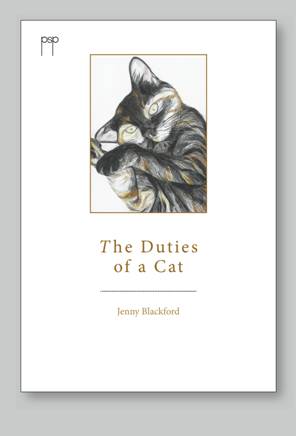
My friend and fellow local poet Jenny Blackford is releasing her new new poetry book 'The Duties of a Cat' published by none other than Pitt Street Poetry, featured a few weeks ago. Jenny will be joined by poets (all amazing) Jean Kent, Judy Johnson, Christopher Pollnitz & Rob Riel. This is an opportunity to get a taste of the upcoming poetry sessions at the Newcastle Writers Festival. Rosemarie Milsom Newcastle Herald Journalist & Newcastle Writers Festival Director will be MC for the evening. About the Book: The Duties of a Cat Twelve feline verses with line drawings by Sydney artist Michael Robson. These poems celebrate the essential nature of the cat, friend
& alien, following in a long & proud tradition of feline verse
from a distinguished lineage of poets. About the Author:
Jenny Blackford won the medal in Classics at the University of
Newcastle, branching to a career in computer networking in Melbourne.
These days she is back in Newcastle and writing full time. Her short
stories are published widely: by Random House, Cosmos magazine and in anthologies such as HarperCollins Dreaming Again.
An historical novel The Priestess and the Slave (Hadley Rille Books) appeared in 2009. Her poems are in Westerly, The Pedestal Magazine, Midnight Echo, Star*Line, Eternal Haunted Summer, Dreams and Nightmares, Strange Horizons, Quadrant and Dolly.
Enjoy a glass of wine and listen to some fabulous poetry. RSVP Essential on (02) 4969 2525 or marketing@macleansbooks.com.au
Venue
MacLean's Booksellers, 69 Beamont Street Hamilton Newcastle
If you read last week's post you'll know that one of the wonderful people joining me for the How Do Poets Survive session at this year's Newcastle Writer's Festival is Christopher Pollnitz. Pollnitz is not only a fine poet himself (as I'll be showing you in a moment), he's a lecturer in English at Newcastle University, as well as being a noted Lawrencian. We're not talking about Lady Chatterly's Lover here. Pollnitz has edited one of the most critical editions of D. H. Lawrence’s Poems, and he is now working on Volume III, which features Lawrence’s draft and uncollected poetry (something I can imagine as a massive undertaking that is as much creation as curation). He is also one of the original founders of the very well-respected Newcastle Poetry Prize. Pollnitz' own work has been published by Rob Riel's Picaro Press which we'll be looking at next week. Just for a taste, here is one stanza from Pollnitz' poem "Satin Bower Bird" which can be read in its entirety (along with other work) in the December issue of Mascara: http://mascarareview.com/christopher-pollnitz-2/
"Black Prince of the undergrowth, to me his crackle
and hiss seem off-station, but you and he have a
thing together. As I finish each two litres
of juice, you put the lids out in the garden
and your pretty boy comes again and again carrying
awkwardly off in his beak the royal blue baubles."
Dare I say that the influence of Lawrence's work on Pollnitz is strong - involving the same taut observation, the same anthropomorphism, the same meta-poetic twist as the awareness of human conceit and the artistic process is played against the natural world. Here is Lawrence's "Eagle in New Mexico" which is taken from the sumptuous hardcover edition of The Cambridge Edition of the Works of D.H. Lawrence: The Poems by Christopher Pollnitz (click on the cover to be taken to the Amazon page for the book - it's quite a beautiful thing:
“Fly off, big bird with a
big black back.
Fly slowly away, with a
rust of fire in your tail,
Dark as you are on your
dark side, eagle of heaven.
Even the sun in heaven can
be curbed and hastened at last
Those of you who have been following this blog for a while will know that last year, in the lead up to the Newcastle Poetry Festival, I ran little profiles of the people who were joining me on my poetry panel - tasters if you will. This year the topic will be "How Do Poets Survive", and I'll be chatting with David Musgrave, who was also on my poetry panel last year, Christopher Pollnitz, Rob Riel, and John Knight of Pitt Street Poetry. This is a free event held onMulubinba Room - Newcastle City Hall, and knowing the work of the amazing poets and poetry publishers who are joining me to discuss the topic of publishing poetry and the dynamic between poet, editor and publisher, I am confident in saying that this will be a session well worth attending, full of lively, topical chatter and lots of opportunity (as with last year) for audience interaction. Today I'm going to kick off the series with a little profile on John Knight's wonderful Pitt Street Poetry press.
Dr John Knight
Anyone who writes poetry and wants it published will be well aware that there aren't very many traditional publishers out there, and most of them are doing it more for love than for the (somewhat less than copious...) financial rewards. The love is often considerable and the resulting collections exquisite, as is clearly the case with PSP, who started up in 2012 with two collections: Travelling with the Wrong Phrasebook by the amazing Jean Kent (who was on our panel last year - you can search her up in the archives for more on Jean and her work), and Light Pressure by John Foulcher. Since then, PSP has grown rapidly and now aims to publish 4-6 new collections a year, as well as pocket-sized editions of out-of-print classics from the last fifty
years. They've got some pretty big names on their books already including the likes of Luke Davies, Ron Pretty, and Mark Tredinnick- just a few of those you might have heard of, though there are plenty more upcoming poetry collections from names familiar and new, with an eclectic mix of e-books, inexpensive pamphlets, paperbacks, and beautiful casebound illustrated and autographed editions that make lovely gifts. As both writer and reader of poetry, I'm so glad that publishers like PSP are continuing to put out the good stuff.
Everyone
needs a little brush-up on their grammar and their editing skills because
everyone is a writer these days. From social networking to writing copy for our
own Web sites to blogging, our writing know-how is on display as it never has
been before. Regardless of our profession. Regardless of our age. Older folks find
that grammar rules and style choices change over time. The youngest group of
writers might need to get over some bad habits fostered by texting. And many
will be surprised that writing online may require a different skillset (other
than the technical part) than writing for print (and vice versa). An example:
If you’re writing for online consumption, you may want to use a type font like
Verdana that was developed for reading on screen. If you’re submitting
something for print as a writer or in the business world, you may be safer with
the tried-and-true New Times Roman that studies have shown is easier to read in
print.
It’s because of these differences and some grammar mistakes
that seem to never go away that I wrote The
Frugal Editorand recently
updated and expanded it in a second edition. The first was published in 2007.
There have been quite a few changes since then—both in recommendations and some
very bad new habits being passed around. You may ask why I included other
suggestions for books other than mine in the Appendix? There is no more frugal
way to keep your skills current and nurture your career (whatever that career
may be) than with books! Here are just a
few from that list:
·Garner’s
Modern American Usage, by
Bryan A. Garner, is excellent for Americans. For our purposes—that is not to
rile an agent or publisher—choose the more formal of possibilities it offers.
If the suggestion feels stilted, rearrange the construction of your sentence.
·Perrin and Smith Handbook of Current English has been around a long time. When you have
read it, you will know the difference between temerity and timidity—or at least
know to look them up. “Half knowing a word may be more dangerous than not
knowing it at all” is the kind of truth you will find within its pages. Trouble
is, you may need to search for it in a bookstore that sells used books or watch
for it at garage sales.
·The
Elements of Style, Fourth Edition, by William Strunk Jr., E. B. White, Roger Angell. See
my cautionary notes in this book about using Elements as if it were The Ten Commandments.
I have more books than I can read. My shelves are stacked three books deep with books squeezed in everywhere they can fit, and new books arrive in the post almost on a daily basis. I don't need more. I turn down offers of books every day, and yet, I'm strangely attracted to the Biblio-Mat. I don't live in Toronto, CA, where the Biblio-Mat is housed - in a very cool looking bookstore called The Monkey's Paw - but if I did, or if there were one near me (there isn't even a bookstore nearby anymore), I'd be at it regularly to put $2 into the machine and take my chances on a randomised antique book, delivered like a gumball, out of the slot at the bottom. Why? It's certainly not because I need something to read - there is a gorgeous stack of great books right here awaiting my attention. Perhaps it's because the machine itself is kind of retro, with a cover like an old Penguin novel. Maybe it's because it makes old fashioned noises like bells, whirs and clinks (and I'm feeling nostalgic for that kind of noise). You can have a look and listen yourself here: http://vimeo.com/53679084. Or maybe it's because, as Stephen Fowler, owner of the Biblio-Mat and The Monkey's Paw puts it, there's a sense that the book that comes out the bottom is choosing you personally. That is, of course, the serendipity that makes it so appealing. It's a lucky dip for readers - a tiny bit of a gamble that won't leave you broke. What book lover could resist that?




 Dare I say that the influence of Lawrence's work on